
The crypto staking landscape has transformed dramatically since proof-of-stake networks first emerged. What was once a technical endeavor requiring specialized knowledge has become accessible to anyone seeking passive income from their digital assets. In 2026, crypto staking represents one of the most straightforward ways to earn rewards while supporting blockchain network security.
This comprehensive guide examines the best crypto staking opportunities available today, comparing protocols, yields, risks, and methods to help you make informed decisions about where to stake your capital.
Understanding Crypto Staking in 2026
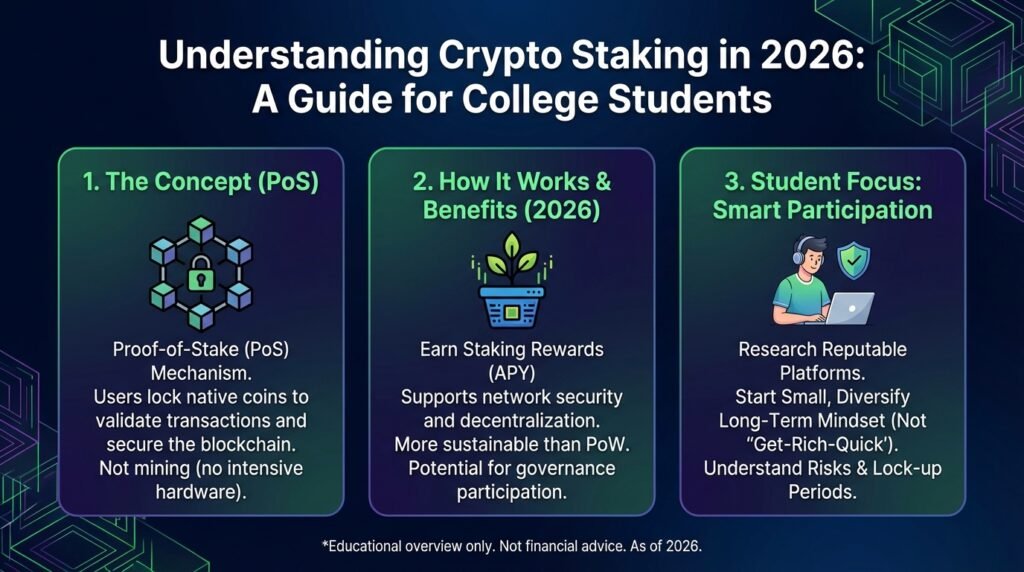
Crypto staking involves locking your tokens to participate in a proof-of-stake blockchain’s consensus mechanism. Think of it as depositing money in a high-yield savings account, except instead of a bank paying you interest, you’re helping secure a decentralized network and earning rewards for that service.
The mechanics are elegant. Validators propose and verify new blocks of transactions. To become a validator, you must stake a specified amount of the network’s native token as collateral. This stake ensures honest behavior because validators risk losing their staked tokens through a process called slashing if they attempt to validate fraudulent transactions or behave maliciously.
As a token holder, you don’t necessarily need to run validator infrastructure yourself. Most networks allow you to delegate your stake to existing validators who operate the hardware and software, sharing the rewards with you while maintaining custody of your tokens or having them in a delegated but still self-custodied state.
The rewards you earn come from different sources depending on the network. Some combine newly minted tokens with transaction fees. Others rely primarily on fee distribution. Understanding these reward mechanisms helps you evaluate the long-term sustainability of staking yields.
The maturation of crypto staking has brought increased competition among networks, better tooling for retail stakers, and more sophisticated risk management options. The days of sketchy validators and confusing interfaces are largely behind us, replaced by professional infrastructure and user-friendly platforms.
Ethereum: The Staking Giant
Ethereum’s transition to proof-of-stake in September 2022 marked a watershed moment for crypto staking. As the second-largest cryptocurrency and the dominant smart contract platform, Ethereum staking has become a cornerstone of the passive income ecosystem.
Current Staking Mechanics
Native Ethereum staking requires 32 ETH, currently valued around $80,000 to $100,000 depending on market conditions. This capital requirement puts direct validation out of reach for many retail participants, though solutions have emerged to address this limitation.
When you stake ETH, your tokens support network consensus by validating transactions and proposing new blocks. The network randomly selects validators to perform these duties, with selection probability proportional to your stake size. Rewards come from both newly issued ETH and transaction fees, including priority fees that users pay for faster transaction processing.
The current Ethereum staking yield hovers between 3.2% and 4.1% annually, varying based on the total amount staked network-wide and fee activity. Higher network usage means more fee revenue for validators, potentially pushing yields toward the upper end of this range. Lower activity depresses yields toward the minimum issuance rewards.
Staking Options and Accessibility
Solo staking represents the purest form but demands technical expertise. You run validator software on dedicated hardware, maintain uptime, and manage security yourself. The rewards are highest with this approach since you’re not sharing with intermediaries, but the operational burden is significant.
Staking pools like Rocket Pool and Lido have democratized Ethereum staking. With Lido, you can stake any amount of ETH and receive stETH, a liquid staking derivative representing your staked ETH plus accrued rewards. This liquidity is transformative because you can use stETH in DeFi protocols while still earning staking rewards, effectively double-dipping on yields.
Rocket Pool operates differently, prioritizing decentralization. Node operators need 16 ETH plus RPL tokens as collateral, and the protocol matches them with stakers who have smaller amounts. Stakers receive rETH, another liquid staking token, while node operators earn additional commission for running infrastructure.
Exchange staking through platforms like Coinbase and Kraken offers maximum convenience. You stake directly through their interface, and they handle all technical aspects. The tradeoff is custodial risk, where the exchange controls your keys, and lower yields due to their commission fees typically ranging from 15% to 25% of earned rewards.
Risks and Considerations
Slashing represents the primary technical risk. If your validator acts maliciously or suffers extended downtime, the network burns a portion of your staked ETH as punishment. In practice, slashing events are rare with competent validators, but choosing reputable node operators or pools is crucial.
Smart contract risk affects liquid staking derivatives. Both Lido and Rocket Pool operate through smart contracts that could contain vulnerabilities. While extensively audited, no code is completely risk-free. Lido in particular has faced criticism for centralization concerns, as its validator set is somewhat limited despite theoretical openness.
Liquidity considerations have improved dramatically since withdrawals were enabled in April 2023. You can now unstake ETH with a withdrawal queue typically processing within days, though this can extend to weeks during periods of mass unstaking. Liquid staking derivatives solve this by allowing immediate selling or trading, though you might face slight discounts during market stress.
Solana: High-Performance Staking
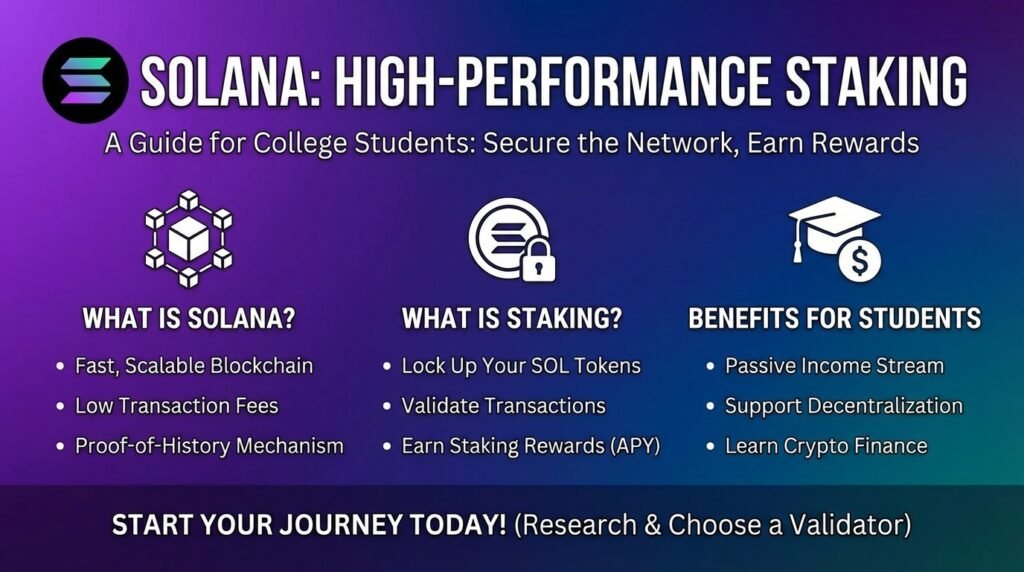
Solana‘s incredible transaction throughput and low costs have made it a favorite among users seeking fast, cheap blockchain interactions. Solana staking offers competitive yields while supporting one of the most actively used networks in crypto.
Staking Infrastructure
Solana staking doesn’t require minimum amounts, making it accessible to holders of any size. You delegate your SOL tokens to validators running the high-performance hardware necessary to keep up with Solana’s demanding technical requirements.
Current yields range from 6.8% to 8.4% annually, notably higher than Ethereum. This premium reflects Solana’s higher inflation rate, which funds validator rewards. The network issues new SOL tokens according to a declining schedule, starting at higher levels and gradually reducing toward a long-term inflation rate around 1.5%.
Epochs on Solana last approximately two days, and you begin earning rewards after staking for one full epoch. This quick activation contrasts with Ethereum’s longer delays and makes Solana staking more responsive to market opportunities.
Native Staking vs Liquid Options
Native delegation through Phantom, Solflare, or other Solana wallets gives you full control. You select validators based on their commission rates, typically 5% to 10%, and their performance metrics. Higher-performing validators with better uptime deliver slightly better rewards, though differences are usually minimal among top operators.
Liquid staking on Solana has grown substantially through protocols like Marinade Finance, Jito, and BlazeStake. These issue liquid staking tokens similar to Ethereum’s model. Marinade’s mSOL and Jito’s jitoSOL can be used throughout Solana DeFi while earning staking yields, though DeFi opportunities on Solana are somewhat more limited than Ethereum.
Exchange staking through Binance, Coinbase, and others remains popular for Solana, particularly because the minimum stake is low and setup is trivial. Commission rates are similar to Ethereum staking, taking a cut of your rewards in exchange for handling all technical aspects.
Risk Profile
Network stability has been Solana’s persistent challenge. The network has experienced multiple outages and periods of degraded performance since launch. While frequency and severity have decreased as the core team improves the protocol, validators occasionally face lost rewards during network instability periods.
Validator selection matters more on Solana than other networks. Poor-performing validators with inadequate hardware miss blocks and deliver lower yields. The community maintains resources tracking validator performance, essential reading before delegating your stake.
Token inflation represents another consideration. Solana’s relatively high inflation rate means your real returns in terms of network ownership percentage are lower than nominal APY suggests. If inflation is 5% and you’re earning 7.5%, your real yield is only about 2.5% in terms of maintaining your proportional network share.
Cardano: Academic Approach to Staking
Cardano’s research-driven development and formal verification methods have created a staking system emphasizing decentralization and sustainability. The network’s Ouroboros proof-of-stake protocol was among the first peer-reviewed consensus mechanisms, and it shows in the careful design.
Delegation Model
Cardano uses a unique delegation approach where you never give up custody of your ADA tokens. Instead, you register your wallet address to stake with a chosen pool, and your tokens remain fully liquid and spendable at all times. This contrasts with many networks requiring actual token lockup.
Current Cardano staking yields approximate 4.5% to 5.2% annually, competitive though not exceptional. The network caps pool rewards to encourage decentralization, preventing any single pool from becoming too dominant. Pools reaching saturation thresholds see diminishing returns, naturally distributing stake across multiple operators.
Epochs on Cardano last five days, and there’s a two-epoch delay before rewards begin. This means you wait approximately ten days after staking to receive your first rewards, somewhat longer than other networks but not prohibitive.
Staking Mechanisms
Native staking through Daedalus or Yoroi wallets is straightforward. You choose from thousands of available pools, considering their pledge amount, margin, fees, and performance. Pool operators who pledge more of their own ADA demonstrate commitment and receive slight reward boosts.
Liquid staking hasn’t gained as much traction on Cardano, partly because native delegation already maintains full liquidity. Projects like Liqwid and Indigo offer synthetic staking derivatives, but adoption remains limited compared to Ethereum and Solana ecosystems.
Exchange staking exists but makes less sense given that native delegation preserves full liquidity anyway. The only advantage is simplicity for users completely unfamiliar with Cardano wallets, though this comes at the cost of commission fees.
Risk Assessment
Cardano’s staking system is among the least risky in major blockchains. There’s no slashing mechanism, so you can’t lose staked tokens to technical failures or validator misbehavior. The worst outcome is simply receiving zero rewards during epochs where your chosen pool has poor performance.
Centralization concerns exist around a few large pools, particularly those operated by exchanges. The community actively encourages delegation to smaller, mission-driven pools to maintain network decentralization, even organizing campaigns to rotate stake periodically.
The main risk is opportunity cost. Cardano’s ecosystem development has lagged behind Ethereum and Solana, limiting DeFi opportunities for your ADA. You earn solid staking rewards but miss yield farming and liquidity provision opportunities available on more developed platforms.
Polkadot: Multi-Chain Staking
Polkadot’s heterogeneous multi-chain architecture creates a unique staking environment where you’re securing not just one blockchain but an entire ecosystem of specialized parachains.
Nominated Proof of Stake
Polkadot uses nominated proof-of-stake, where DOT holders nominate up to 16 validators they trust. The network then elects a validator set from these nominations using sophisticated algorithms balancing security and decentralization.
Minimum stake requirements of 250 DOT, worth approximately $2,000 to $2,500, create a meaningful barrier to entry. This threshold reflects the technical sophistication of Polkadot’s system and helps ensure serious participation from nominators.
Current yields range from 14% to 16% annually, among the highest of major networks. These elevated returns stem from Polkadot’s inflation model, which adjusts dynamically based on staking participation rates. The network targets around 75% of DOT being staked, increasing or decreasing inflation to incentivize movement toward this target.
Staking Implementation
Native nomination through Polkadot.js or compatible wallets requires choosing validators carefully. With limited nomination slots, you want validators with strong performance records, reasonable commission rates of 1% to 3%, and sufficient stake backing to reliably join the active set.
Bonding periods of 28 days present significant liquidity constraints. Once you initiate unstaking, your DOT remains locked for four weeks before becoming transferable. This lengthy period demands confidence in your decision to stake since quick exits aren’t possible.
Liquid staking through Acala’s LDOT or Parallel’s sDOT provides alternatives with immediate liquidity. These protocols handle nomination complexity while giving you liquid tokens usable in Polkadot DeFi. The tradeoff is smart contract risk and slightly reduced yields after protocol fees.
Exchange staking through Kraken and Binance offers the simplest entry but with familiar downsides of custodial risk and reduced rewards.
Unique Considerations
Polkadot’s era system compounds rewards automatically every 24 hours, making it one of the most frequent compounders among major networks. This daily compounding meaningfully increases effective yields compared to networks compounding weekly or monthly.
Slashing exists on Polkadot and can be severe. Major violations by validators can result in 100% of their stake being slashed, with nominators losing a proportional amount. This makes validator selection critical, favoring established operators with strong technical capabilities.
Governance participation is deeply integrated with staking. Your staked DOT can vote on governance proposals, treasury spending, and technical upgrades without unstaking. This dual utility adds value beyond pure yield generation.
Cosmos: The Internet of Blockchains
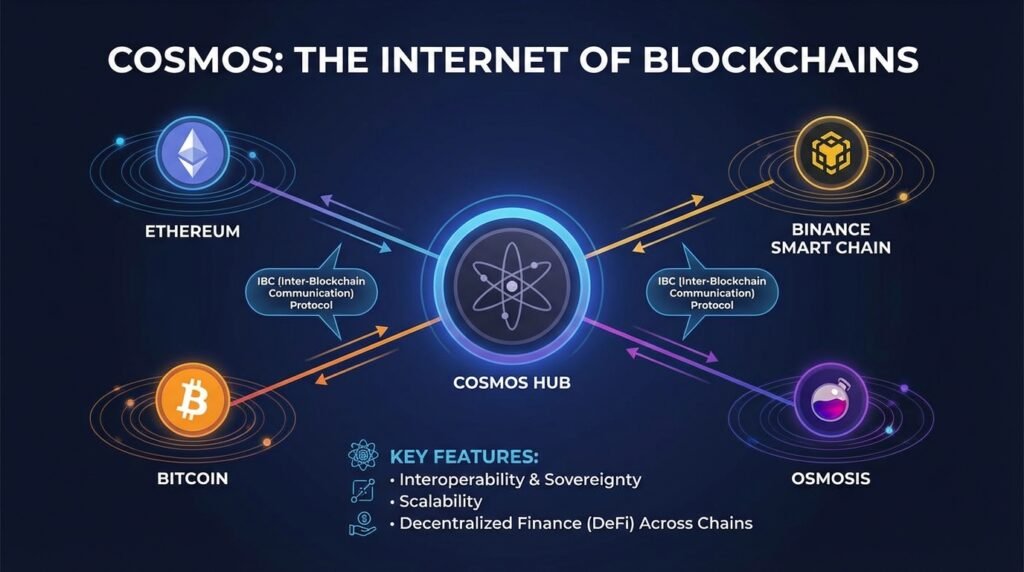
Cosmos pioneered interoperability between independent blockchains, creating an ecosystem where dozens of chains use similar staking mechanics through the Cosmos SDK framework. ATOM, the native token of the Cosmos Hub, represents the central chain in this network.
Delegation Framework
Cosmos staking is straightforward, with no minimum amounts required. You delegate ATOM to validators operating infrastructure for the Cosmos Hub, earning a share of block rewards and transaction fees.
Current yields approximate 18% to 21% annually, driven by Cosmos’s inflation schedule that adjusts based on bonding ratios similar to Polkadot. Lower staking participation increases inflation to incentivize more bonding, while higher participation decreases it.
The unbonding period of 21 days locks your ATOM during withdrawal, similar to Polkadot though slightly shorter. This three-week window represents your commitment to network security and gives time to detect and punish malicious validator behavior.
Staking Approaches
Native delegation through Keplr or Cosmostation wallets provides full control. You choose from hundreds of validators, considering commission rates of 5% to 10%, voting power distribution to support decentralization, and community involvement.
Liquid staking through Stride offers stATOM with immediate liquidity. The protocol operates across the Cosmos ecosystem, using IBC (Inter-Blockchain Communication) to manage staking positions while giving users liquid tokens. Persistence and pStake offer similar services with slight mechanical variations.
Exchange staking availability varies, with some platforms supporting ATOM staking while others don’t. Given the ease of native delegation and attractive yields, there’s less reason to use exchanges for Cosmos staking compared to more technically complex networks.
Risk Landscape
Slashing on Cosmos is relatively mild compared to Polkadot. Validators can lose 0.01% of stake for excessive downtime and up to 5% for double-signing blocks. Delegators share proportional losses, but catastrophic slashing is rare with reputable validators.
The real consideration is ATOM’s value proposition. As the Cosmos ecosystem has grown, individual chains have become less dependent on ATOM and the Cosmos Hub. This has sparked debates about ATOM’s long-term value capture, though recent upgrades like liquid staking modules and interchain security aim to strengthen the Hub’s position.
Governance is highly active on Cosmos, requiring attention to proposals that can significantly impact staking rewards, inflation schedules, and tokenomics. Engaged participation benefits from following community discussions and understanding proposed changes.
Avalanche: Subnet Staking Ecosystem
Avalanche’s unique subnet architecture allows customized blockchain creation within the broader network. AVAX staking secures the primary network while enabling participation in subnet validation for additional rewards.
Primary Network Staking
Avalanche requires a minimum stake of 2,000 AVAX, approximately $80,000 to $100,000, for running a validator on the primary network. This steep requirement limits direct validation to serious participants.
Delegation requires only 25 AVAX minimum, making it far more accessible for most users. Current delegation yields range from 7% to 9% annually, competitive within the staking landscape.
Staking periods are fixed and chosen at the time of delegation, ranging from two weeks to one year. Longer commitments receive higher yields, incentivizing long-term network security. This fixed-term model differs from most networks allowing immediate unstaking initiation.
Implementation Options
Native staking through the Avalanche Wallet or Core Wallet involves choosing a validation period and selecting a validator. Once committed, your AVAX is locked for the chosen duration, earning rewards paid at the end of the staking period.
Liquid staking through protocols like Benqi’s sAVAX or GoGoPool provides alternatives with immediate liquidity. These tokens represent staked AVAX and can be used in Avalanche DeFi protocols like Trader Joe and Aave, allowing simultaneous staking rewards and DeFi participation.
Exchange staking through platforms like Binance and Kraken offers standard custodial staking services, handling all technical requirements in exchange for commission fees.
Risk Elements
The fixed-term lockup is a double-edged sword. It provides commitment certainty for network security but eliminates flexibility during the staking period. If market conditions change dramatically, you cannot exit until your term completes.
Subnet validation represents additional opportunities but also risks. Validating subnets requires staking on the primary network first, then additional collateral for specific subnets. Subnet rewards vary widely based on their tokenomics and usage, potentially outperforming primary network rewards but also facing higher risks.
Validator selection requires checking uptime statistics and community reputation. Poor-performing validators deliver lower rewards, and while there’s no slashing on Avalanche’s primary network, opportunity cost from missed rewards is meaningful.
Newer Layer 2 Staking Opportunities
The emergence of layer 2 networks on Ethereum has created novel staking opportunities with unique characteristics compared to layer 1 blockchains.
Optimism and OP Token
Optimism’s governance token OP can be delegated to governance participants who vote on protocol proposals. While not traditional staking in the proof-of-stake sense, delegation earns rewards from ecosystem initiatives and foundation programs.
Current incentives vary widely based on specific programs, sometimes reaching 5% to 8% from ecosystem grants and retroactive public goods funding. These aren’t guaranteed like validation rewards but represent value creation from active participation.
The risk profile is largely governance-focused. Delegating to effective governance participants who propose valuable initiatives and vote wisely increases the value of OP and the broader ecosystem. Poor governance can harm the network and token value.
Base and Emerging L2s
Base, Coinbase’s layer 2 network, currently doesn’t have native staking for a Base-specific token. However, since it’s built on the OP Stack, future governance token launches could introduce staking opportunities similar to Optimism.
Other layer 2 networks like Arbitrum offer ARB token delegation for governance participation. Rewards come primarily from ecosystem growth and governance influence rather than direct staking yields, representing a different value capture mechanism.
The opportunity with emerging L2s lies in early participation. Native tokens for newer layer 2 networks often launch with aggressive incentive programs to bootstrap participation, potentially offering attractive yields during initial phases before normalizing.
Staking Comparison Table
| Network | Current APY | Min. Stake | Lock-up Period | Slashing Risk | Liquidity Options |
|---|---|---|---|---|---|
| Ethereum | 3.2% to 4.1% | 32 ETH (native) / Any (pool) | Variable withdrawal queue | Yes, severe | stETH, rETH (liquid) |
| Solana | 6.8% to 8.4% | None | 2-4 days | Minimal | mSOL, jitoSOL (liquid) |
| Cardano | 4.5% to 5.2% | None | None (liquid native) | No slashing | Native liquidity |
| Polkadot | 14% to 16% | 250 DOT | 28 days | Yes, severe | LDOT, sDOT (liquid) |
| Cosmos | 18% to 21% | None | 21 days | Yes, moderate | stATOM (liquid) |
| Avalanche | 7% to 9% | 25 AVAX | 2 weeks to 1 year | No slashing | sAVAX (liquid) |
Algorand: Pure Proof of Stake
Algorand’s pure proof-of-stake mechanism offers one of the simplest staking experiences in the cryptocurrency space, though recent changes have significantly altered its reward structure.
Governance Participation
Current Algorand staking operates primarily through governance participation rather than continuous validation rewards. You commit ALGO tokens to vote on governance proposals during quarterly governance periods, earning rewards for participation and voting.
Yields from governance range from 5% to 8% annually, distributed quarterly to participants who maintain their commitment and vote on proposals. This differs from traditional staking where rewards accrue continuously.
No lockup exists in the traditional sense. You commit to keeping ALGO in your wallet during the governance period and voting on proposals. Early withdrawal is possible but forfeits that quarter’s rewards.
Practical Implementation
Participation requires an Algorand wallet like Pera or MyAlgo. You register for governance through the Algorand Foundation’s governance portal, committing a specific amount of ALGO for the upcoming period.
During the governance period, typically three months, proposals emerge for community voting. You must vote to remain eligible for rewards. After the period concludes, rewards are distributed to eligible participants.
DeFi integration with Algorand governance has emerged through platforms like Folks Finance, allowing you to commit ALGO to governance while simultaneously using it as collateral for borrowing. This creates leveraged governance strategies, though with added complexity and liquidation risk.
Risk Considerations
The primary risk is accidentally breaking your commitment. If your wallet balance drops below your committed amount at any point during the period, you become ineligible for rewards. This requires careful management of your ALGO holdings to avoid accidental disqualification.
Governance voting requires attention and informed participation. While missing one vote doesn’t disqualify you, the system encourages thoughtful participation in network decision-making rather than passive reward collection.
The lower yields compared to some alternatives reflect Algorand’s lower inflation and emphasis on sustainable tokenomics. However, this same sustainability makes the rewards more predictable and less dependent on unsustainable emission schedules.
Tezos: Self-Amending Blockchain
Tezos pioneered on-chain governance with automatic protocol upgrades, creating a staking environment where bakers (validators) play crucial roles in both consensus and governance.
Baking and Delegation
Tezos uses “baking” terminology for its validation process. Bakers stake minimum 6,000 XTZ (approximately $20,000 to $25,000) to run validation nodes. Smaller holders delegate to bakers, earning a share of baking rewards minus the baker’s fee.
Current yields approximate 5.5% to 6.8% annually, funded by protocol inflation. Tezos has implemented several upgrades reducing inflation over time, gradually decreasing nominal yields while improving sustainability.
There’s no explicit unbonding period. Delegation changes take effect after a few cycles (roughly 2-3 weeks), but your tokens remain liquid and spendable throughout. This flexibility makes Tezos staking less restrictive than many alternatives.
Staking Methods
Native delegation through Temple Wallet or Kukai involves choosing from dozens of public bakers. Consider their fee structures, typically 5% to 15% of rewards, their capacity, and community reputation.
Liquid staking through youves offers uXTZ, wrapped XTZ that continues earning staking rewards while remaining usable in Tezos DeFi protocols. Adoption is limited compared to Ethereum’s liquid staking ecosystem but growing.
Exchange staking through Coinbase and Kraken provides custodial alternatives, suitable for users prioritizing convenience over self-custody and optimal yields.
Risk Analysis
Tezos features bonding requirements where bakers deposit collateral that can be slashed for protocol violations. However, delegators don’t face direct slashing risk. Your exposure is limited to choosing a baker who performs poorly or goes offline, resulting in missed rewards rather than lost principal.
The Tezos ecosystem has struggled with developer mindshare compared to Ethereum or Solana. While technically capable, lower DeFi activity limits opportunities beyond basic staking, potentially reducing overall yield opportunities.
Governance is deeply integrated with baking. Protocol amendments require baker approval, giving them significant influence over network evolution. Engaged delegators should monitor their baker’s voting patterns to ensure alignment with their preferences.
Near Protocol: Sharding for Scale
Near Protocol’s sharded architecture positions it for high throughput while maintaining decentralization. NEAR staking reflects this technical sophistication with some unique characteristics.
Delegation Mechanics
Near requires minimum 1 NEAR to stake, essentially no barrier to entry. You delegate to validator pools that operate chunks (shards) within Near’s architecture, earning a portion of inflation rewards and transaction fees.
Current yields range from 9% to 11% annually, attractive compared to many alternatives. Near’s inflation is relatively high at around 5% annually, decreasing 5% per year, which funds these rewards.
Unbonding takes 2-3 epochs (approximately 36-52 hours), among the shortest lock-up periods in proof-of-stake networks. This quick liquidity makes Near staking relatively flexible compared to networks requiring weeks for unstaking.
Implementation Approaches
Native staking through Near Wallet or Sender Wallet provides direct control. You choose validators based on their fee percentages, typically 5% to 10%, and their stake backing which indicates community trust.
Liquid staking through Meta Pool offers stNEAR, maintaining liquidity while earning rewards. Linear Protocol provides similar services with slight mechanical differences. These solutions enable DeFi participation on Near’s growing ecosystem while maintaining staking exposure.
Exchange support for Near staking is limited compared to larger cap cryptocurrencies, making native staking or liquid staking protocols the primary options for most users.
Risk Profile
Near implements slashing for validator misbehavior, though events have been extremely rare. The protocol monitors uptime and correct block production, slashing stake for extended failures or malicious actions.
Validator selection matters significantly. The active validator set is limited, and validators need sufficient total delegation to reliably remain active. Choosing validators near the bottom of the active set risks them being cycled out, interrupting your rewards.
The sharding complexity introduces theoretical risks around network coordination and security compared to non-sharded chains. Near has operated smoothly since launch, but the theoretical attack surface is larger.
Choosing Between Native Staking and Exchanges
The decision between self-custody native staking and exchange-based staking involves tradeoffs across security, convenience, returns, and control.
Native Staking Advantages
Self-custody means you control your private keys, eliminating counterparty risk from exchanges. No exchange bankruptcy, regulatory seizure, or exit scam can touch properly secured assets in your hardware wallet.
Higher yields result from eliminating the exchange’s cut. Native staking typically delivers 15% to 30% higher returns by removing intermediary fees, meaningful over years of compounding.
Network participation lets you choose validators aligned with your values, supporting decentralization by delegating to smaller operators rather than large exchange-run validators that concentrate power.
Direct governance participation on networks like Cosmos, Tezos, and Algorand requires self-custody. Exchange staking often doesn’t allow you to vote with your staked tokens, forfeiting your voice in protocol evolution.
Exchange Staking Benefits
Simplicity is the overwhelming advantage. A few clicks stake your tokens without setting up wallets, researching validators, or managing keys. For newcomers, this reduced friction enables participation that might not otherwise happen.
Tax reporting becomes simpler with exchange staking. Exchanges provide consolidated statements showing your rewards, whereas tracking self-custodied staking rewards across multiple wallets and protocols requires more effort.
Instant liquidity on some exchanges allows unstaking and selling immediately, while native staking often requires waiting through unbonding periods. This flexibility matters for traders rather than long-term holders.
Integration with trading strategies means staked assets on exchanges can sometimes be used as collateral for margin trading or other advanced strategies, though this introduces additional risk.
Security Comparison
Hardware wallets provide maximum security for native staking. Ledger and Trezor devices keep your keys offline, requiring physical device confirmation for transactions. Even if your computer is compromised, your funds remain safe.
Software wallets like MetaMask, Keplr, and Phantom offer convenience with moderate security. They’re suitable for moderate amounts but shouldn’t hold life-changing wealth given their connection to internet-connected devices.
Exchange custody concentrates risk. You’re trusting the exchange’s security, regulatory compliance, and financial stability. Major exchanges are generally reliable, but history includes spectacular failures like FTX, Mt. Gox, and others.
Multi-signature and smart contract wallets provide institutional-grade security for large staking positions. Platforms like Gnosis Safe require multiple parties to approve transactions, preventing single points of failure.
Hardware vs Software Wallet Considerations
The wallet you choose for staking significantly impacts security, convenience, and sometimes even available features.
Hardware Wallet Staking
Ledger devices support staking for most major proof-of-stake networks directly through Ledger Live. You can stake Ethereum, Solana, Cosmos, Tezos, Algorand, and others without ever exposing your private keys to an internet-connected device.
Trezor provides similar functionality though with somewhat more limited direct integration. Many networks require using the Trezor device with third-party interfaces like MetaMask or network-specific wallets, adding complexity.
The security benefit is paramount. Your private keys never leave the hardware device. Transaction signing happens on the device itself, displaying transaction details for your verification before signing.
The convenience cost is real. Hardware wallet transactions require physically connecting the device, entering PINs, and confirming on the device screen. For frequent operations, this becomes tedious compared to software wallet one-click experiences.
Software Wallet Options
Network-specific wallets often provide the best staking experiences. Phantom for Solana, Keplr for Cosmos ecosystem chains, and Yoroi for Cardano are optimized for their respective networks with intuitive staking interfaces.
Multi-chain wallets like MetaMask support numerous networks through custom RPC connections but may lack native staking support for some chains, requiring you to use web interfaces instead.
Mobile wallet apps enable staking on the go. Trust Wallet, Atomic Wallet, and others support staking for multiple networks directly from your phone, convenient for monitoring and managing positions anywhere.
Browser extension wallets provide seamless DeFi integration. Staking from MetaMask or Phantom while browsing decentralized exchanges and protocols creates smooth workflows for advanced strategies.
Hybrid Approaches
Many experienced users combine hardware and software wallets strategically. Large holdings stay in hardware wallets for security, while smaller “hot wallet” amounts in software wallets enable frequent operations without hardware wallet friction.
Watch-only wallet configurations let you monitor hardware wallet addresses through software interfaces without exposing private keys. You can check balances and staking status conveniently while maintaining security.
Multi-signature setups using both hardware and software signers create flexible security models. You might require two of three signatures to move funds, with one hardware wallet, one phone app, and one desktop wallet as signers.
Compounding Strategies for Maximum Returns
The difference between simple and compounded returns becomes massive over years, making compounding strategies essential for serious stakers.
Auto-Compounding Mechanisms
Some networks compound automatically. Cardano adds rewards to your stake automatically, instantly increasing future reward calculations. Polkadot’s daily era rewards compound automatically without manual claiming.
Other networks require manual claiming. Ethereum, Solana, and Cosmos accumulate rewards separately from your stake. You must periodically claim and restake them to achieve compounding, with each claim/restake incurring transaction fees.
Liquid staking protocols typically auto-compound. stETH from Lido automatically includes accrued rewards in its growing value relative to ETH. You don’t receive separate reward tokens but rather your liquid staking token appreciates, representing stake plus rewards.
Third-party compounding services charge fees but handle optimization. They batch claims from multiple users, splitting transaction costs, and execute at optimal times based on gas prices and reward accumulation.
Calculating Optimal Compounding Frequency
The formula balances reward accumulation against transaction costs. More frequent compounding increases effective yield through more compounding periods, but each compound operation costs gas fees.
On Ethereum mainnet with expensive gas, compounding daily would cost far more than the incremental yield benefit. Optimal frequency might be monthly or even quarterly for smaller positions.
On low-fee chains like Solana or Cosmos, weekly or even daily compounding makes sense since transaction costs are negligible compared to the compounding benefit.
The mathematical break-even point occurs when the additional yield from more frequent compounding equals the transaction cost. For a 5% annual yield on $10,000 (earning $500 yearly), if compounding costs $5, you can afford up to 100 compoundings annually before fees exceed benefits.
Advanced Compounding Tactics
Batch operations consolidate multiple actions into single transactions. Some wallets and protocols allow claiming rewards and restaking in one transaction rather than two, halving costs.
Gas price optimization means monitoring network congestion and executing compounds during low-activity periods. Ethereum gas prices vary 10x between peak and off-peak times, dramatically affecting profitability.
Cross-subsidization uses high yields from some positions to fund compounding of others. If you’re earning 20% on a new protocol with auto-compounding while simultaneously earning 5% on Ethereum that requires manual compounding, the high-yield position’s gains subsidize optimizing the lower-yield position.
Tax-efficient compounding considers tax implications of each claim. In some jurisdictions, each reward claim triggers taxable income. Minimizing claim frequency within reasonable compounding parameters reduces tax reporting burden and potentially defers tax liability.
Tax Implications of Crypto Staking
Understanding the tax treatment of crypto staking is crucial for compliance and optimizing after-tax returns.
Income Recognition
Most tax jurisdictions treat staking rewards as ordinary income when received, valued at fair market value at the moment they hit your wallet. This applies whether you immediately sell them or hold them.
The timing question has nuances. Are rewards “received” when they accrue to your validator balance or when you explicitly claim them? U.S. guidance suggests taxation occurs when you gain dominion and control, which for most protocols means when you can freely transfer or sell the rewards.
Auto-compounding protocols create interesting questions. If Lido automatically compounds your staking rewards into more stETH without you taking any action, have you received taxable income? Conservative interpretations say yes, though the exact mechanics remain somewhat unclear.
Exchange staking often simplifies this by paying rewards in discrete distributions that clearly constitute receipt, though you still need to determine fair market value at each distribution time.
Capital Gains on Disposal
When you eventually sell your staking rewards, you trigger capital gains or losses. Your cost basis is the fair market value when you initially received them as income.
This creates potential for both double taxation and tax savings. If rewards were worth $100 when received and $150 when sold, you paid ordinary income tax on $100 and capital gains tax on $50. If they dropped to $75 when sold, you paid ordinary income tax on $100 but get a $25 capital loss deduction.
Long-term vs short-term capital gains treatment depends on your holding period from when you received the rewards. Hold more than one year for preferential long-term rates in most jurisdictions.
The stake itself also has capital gains implications. If you bought ETH for $1,500 and stake it when it’s worth $2,500, you might trigger a taxable event on the $1,000 gain, depending on whether staking constitutes a disposal. This remains legally unclear in many jurisdictions.
Record Keeping Requirements
Detailed transaction logs are essential. Record every reward claim with the date, time, token amount, and USD value at that moment. Record every restaking, compounding, or delegation action.
Crypto tax software like Koinly, CoinTracker, and TokenTax can help but aren’t perfect for complex staking situations. They often misclassify liquid staking tokens, miss auto-compounded rewards, or incorrectly calculate cost basis.
Manual verification is necessary even with software. Review every transaction the software imports, ensuring correct categorization as income, capital gain/loss, or non-taxable transfers.
Professional tax advice becomes worthwhile for substantial staking operations. CPAs specializing in cryptocurrency can navigate unclear regulations and make defensible judgments on ambiguous situations.
Building a Diversified Staking Portfolio
Just as traditional investors diversify across asset classes, crypto stakers should spread risk across multiple networks and strategies.
Portfolio Construction Principles
Core holdings should prioritize safety and liquidity. Ethereum and other large-cap, well-established networks deserve 50% to 70% of your staking portfolio. These provide stable, sustainable yields with minimal protocol risk.
Growth positions in mid-cap networks like Avalanche, Near, or Cosmos can occupy 20% to 35% of your portfolio. These offer higher yields and growth potential but with increased risk from smaller market caps and less battle-tested infrastructure.
Speculative allocations to new networks and high-yield opportunities should remain under 10% to 15% of your total staking capital. These are venture-style bets where you accept high failure probability for occasional outsized returns.
Rebalancing quarterly or semi-annually maintains your target allocations as some positions grow faster than others. This enforces discipline of taking profits from winners and adding to underperforming but fundamentally sound positions.
Risk Management Strategies
Position sizing limits downside from any single protocol. No single network should exceed 25% to 30% of your staking portfolio, ensuring that even catastrophic failure doesn’t destroy your entire stake.
Validator diversification within each network reduces concentration risk. If staking Cosmos, delegate across three to five different validators rather than one. If one experiences technical problems or slashing, others continue earning.
Geographic validator distribution matters for political and regulatory risk. Validators concentrated in one jurisdiction face coordinated regulatory action or infrastructure failures. Choose validators spread across multiple countries when possible.
Liquid staking allocations provide emergency liquidity. Keeping 30% to 50% of your staking portfolio in liquid staking derivatives means you can quickly sell without waiting through unbonding periods if you need capital or see better opportunities.
Sample Portfolio Allocations
Conservative portfolio for capital preservation:
- 50% Ethereum (stETH for liquidity)
- 30% Cardano (native delegation)
- 20% Algorand (governance participation)
- Expected yield: 4% to 5.5% annually with minimal risk
Balanced portfolio for steady growth:
- 35% Ethereum (mixed stETH and native)
- 25% Solana (mSOL liquid staking)
- 20% Polkadot (native delegation)
- 15% Cosmos (stATOM liquid staking)
- 5% Avalanche (sAVAX liquid staking)
- Expected yield: 7% to 10% annually with moderate risk
Aggressive portfolio for maximum returns:
- 25% Ethereum (rETH for decentralization)
- 20% Polkadot (native delegation)
- 20% Cosmos (native delegation)
- 15% Solana (native delegation)
- 10% Near (liquid staking)
- 10% emerging L1/L2 opportunities
- Expected yield: 11% to 16% annually with higher risk
Common Mistakes to Avoid
Learning from others’ errors can save you costly mistakes in your staking journey.
Chasing Unsustainable Yields
Extremely high APYs exceeding 50% to 100% almost always indicate temporary incentive programs or unsustainable token emissions. These rates collapse as emissions decrease or early farmers dump tokens, often leaving latecomers with losses.
New protocol launches frequently offer temporarily high yields to attract initial liquidity. While sometimes profitable for early participants, entering late in these cycles typically results in buying inflated tokens that subsequently crash.
Evaluate yield sustainability by examining the source. Trading fees and network transaction fees create sustainable yields. Token emissions create temporary yields that decrease over time unless token price appreciation compensates.
Ignoring Lock-up Periods
Staking significant portions of your portfolio without considering liquidity needs creates forced selling at inopportune times. If you stake everything with 28-day unbonding and then need capital, you’re forced to sell other assets potentially at losses.
Market timing becomes impossible with long lock-ups. If you recognize warning signs of a market downturn but your stake is locked for weeks, you can’t protect yourself by exiting to stablecoins.
Emergency funds should never be staked with long unbonding periods. Maintain liquid reserves covering 6 to 12 months expenses before locking capital in staking positions, especially those with extended unbonding.
Poor Validator Selection
Choosing validators based solely on the lowest commission often backfires. The cheapest validators may be underfunded, use inadequate infrastructure, or lack technical expertise, resulting in poor performance that costs more than the commission savings.
Over-delegating to large validators centralizes the network and often provides worse returns. Many networks cap validator rewards or decrease returns for oversaturated validators, naturally encouraging distribution.
Neglecting validator voting records on governance networks means delegating to validators whose governance positions contradict your preferences. Active networks like Cosmos and Tezos have frequent proposals significantly impacting protocol direction.
Neglecting Security
Using exchange custodial staking for large amounts trades security for convenience unwisely. For positions exceeding $10,000 to $25,000, self-custody through hardware wallets becomes essential despite the additional complexity.
Reusing passwords across wallets and protocols creates cascading failures when one service is compromised. Use unique, strong passwords for every wallet and service, preferably managed through password managers.
Ignoring smart contract risks of liquid staking protocols means blindly trusting code that controls significant value. Even audited protocols can contain vulnerabilities, making it wise to limit exposure to any single liquid staking solution.
Future of Crypto Staking
The staking landscape continues evolving rapidly with several trends shaping the future.
Restaking and Layered Security
EigenLayer’s restaking concept allows ETH stakers to simultaneously secure other protocols, earning additional yields beyond base Ethereum staking. This “rehypothecation” of security creates layered yield opportunities but also concentrates risk.
Other networks are developing similar restaking mechanisms. The idea of using your stake to secure multiple protocols simultaneously could become standard, dramatically increasing capital efficiency for stakers.
The risk considerations are significant. Restaking introduces slashing risks from multiple protocols simultaneously. A vulnerability in any protocol you’re securing could slash your entire stake, making restaking inherently riskier than simple staking.
Institutional Staking Growth
Traditional financial institutions increasingly offer crypto staking services to clients. Fidelity, Northern Trust, and others provide custody and staking, bringing regulatory compliance and insurance but also introducing traditional finance intermediation.
This institutional involvement legitimizes staking and could drive massive capital inflows, but it also threatens decentralization as a few large institutions control increasing portions of network stake.
Regulatory clarity around staking will continue developing. The SEC’s stance on whether staking services constitute securities offerings remains unclear, with potential dramatic impacts on how exchanges and protocols offer staking services.
Cross-Chain Staking Innovation
Multi-chain staking protocols allowing you to stake one asset to secure multiple chains create efficiency gains. You might stake ETH to secure Ethereum while simultaneously securing Ethereum L2 networks and application-specific chains.
Liquid staking tokens becoming more standardized and interoperable could enable sophisticated strategies. Imagine using stETH as collateral on any chain to borrow and stake other networks’ tokens, creating leveraged multi-chain positions.
The emergence of cross-chain security models like Cosmos’s interchain security allows new chains to rent security from established chains’ staker sets, creating new staking revenue streams while helping new chains launch securely.
Conclusion
Crypto staking in 2026 offers viable passive income opportunities across diverse networks with varying risk and return profiles. From Ethereum’s industry-standard security to Cosmos’s high yields and Cardano’s simplicity, options exist for every risk tolerance and technical capability.
Success in crypto staking requires understanding network mechanics, carefully selecting validators or protocols, managing liquidity needs through appropriate lock-up choices, and maintaining realistic expectations about sustainable yields versus temporary incentive programs.
The infrastructure has matured dramatically, with liquid staking providing flexibility, hardware wallets ensuring security, and established protocols offering battle-tested reliability. These improvements make staking more accessible than ever while simultaneously demanding more sophisticated risk assessment.
Start small to learn mechanics and build experience. Stake modest amounts on user-friendly networks like Cardano or Solana before committing serious capital to more complex protocols like Polkadot. Use this learning period to understand rewards timing, unbonding processes, and the emotional experience of seeing your stake fluctuate with market prices.
Prioritize security over convenience for significant positions. The extra effort of hardware wallets and self-custody pays off through eliminated counterparty risk and higher yields over years of compounding.
Diversify across multiple networks and validators. No protocol is perfectly secure, and spreading your stake protects against protocol-specific risks while exposing you to various growth opportunities across the expanding proof-of-stake ecosystem.
Remain engaged with protocol governance and development. Staking isn’t truly passive if done optimally. Monitor validator performance, participate in governance when possible, and stay informed about protocol upgrades and tokenomic changes affecting your rewards.
The crypto staking landscape will continue evolving with new networks launching, existing protocols upgrading, and innovative mechanisms like restaking emerging. Maintaining flexibility and willingness to adapt your strategy ensures you capture opportunities while avoiding being locked into obsolete approaches.
With realistic expectations, proper security, and thoughtful diversification, crypto staking can generate meaningful passive income while supporting the infrastructure of decentralized networks that represent the future of digital finance.
Learn more about staking