
If you have spent any time around crypto, you have probably heard someone casually mention they are earning 12% APY on their ETH, or that their stablecoins are generating income while they sleep. Your first reaction was probably either excitement or suspicion. Both reactions are completely reasonable.
Here is the reality: passive income from crypto is legitimate, and the mechanisms behind it are grounded in real economic activity. But it is also one of the most misunderstood corners of the digital asset world. People either jump in without understanding how money is actually generated, or they dismiss it entirely because they have heard horror stories about collapsed protocols and rug pulls.
This guide was written to cut through both extremes with clarity and honesty.
What you are about to read is a complete, practical, and deeply researched walkthrough of how crypto yield actually works. You will learn where returns come from, where the genuine risks live, which strategies fit which types of investors, and how to build a yield-generating portfolio without making the mistakes that wipe people out year after year.
Whether you are completely new to crypto or you have been holding assets for years without putting them to work, this is the right place to start.
What Does “Crypto Yield” Actually Mean?
Before anything else, let us establish a clear definition.
In traditional finance, yield refers to the return you earn on an investment over time. Think of interest on a savings account, dividends paid by a stock, or rent collected on a property. Crypto yield is built on the same fundamental concept, adapted for digital assets and blockchain-based financial infrastructure.
When you earn crypto yield, you are generating returns on top of the assets you already hold. Instead of sitting on Bitcoin or Ethereum and waiting for the price to appreciate, you are putting those assets to work by lending them, staking them, providing liquidity, or participating in decentralized protocols, and getting paid for doing so.
The term “cryptoyield” has emerged to describe this entire ecosystem of strategies. It covers every mechanism, platform, and protocol that allows you to earn passive income from your crypto holdings. The range is wide, from the relatively straightforward act of staking ETH directly on the Ethereum network, to complex multi-protocol yield farming strategies that stack returns on top of each other.
What separates crypto yield from traditional yield is the underlying infrastructure. There are no banks acting as intermediaries, no institution keeping a spread between what it pays you and what it charges borrowers. Instead, smart contracts, which are self-executing programs deployed on a blockchain, handle the mechanics automatically and transparently, without requiring permission from any central authority.
This creates genuine opportunities that do not exist in traditional finance: yields ranging from 3% to 30% and sometimes higher, available to anyone with an internet connection, at any hour, on any day of the year.
It also creates risks that do not exist in traditional finance. Ignoring those risks is the fastest way to lose your capital.
Where Does Crypto Yield Actually Come From?
Skeptics often ask a pointed question: if a DeFi protocol is offering 15% APY on a stablecoin, where does that money actually come from? In traditional banking, the answer is simple. A bank borrows your money cheaply and lends it out at a higher rate. In crypto, the sources of yield are more varied, and understanding them is the single most important skill you can develop before committing capital.
Real Economic Demand
The most durable crypto yields are generated by genuine economic activity. Traders want to borrow assets to take leveraged positions. Businesses need liquidity without selling their crypto holdings. Arbitrageurs need capital to exploit price differences across exchanges. When you provide assets to protocols serving these users, the interest and fees they pay flow back to you as yield.
This is the same principle that makes traditional banking work, implemented through code rather than institutions.
Protocol Incentives and Token Emissions
Many DeFi protocols, especially newer ones, subsidize their yields by distributing their own governance or utility tokens to participants. This is commonly called liquidity mining. You provide something the protocol needs, usually liquidity or staked capital, and in return you receive freshly minted tokens on top of any base yield.
This is where yields can get suspiciously high. A protocol offering 200% APY in its own token is essentially printing money to attract users. The yield is technically real in the sense that you receive tokens, but whether those tokens retain value depends entirely on whether the protocol achieves genuine adoption. Most do not. The tokens inflate, early participants sell them, and latecomers absorb the losses.
Understanding the difference between yield backed by real economic activity and yield manufactured through token inflation is one of the most valuable distinctions you can make in this space.
Network Validation Rewards
In proof-of-stake blockchain networks, validators confirm transactions and maintain network integrity. In exchange for locking up tokens as a security deposit (known as staking) and performing this validation role, they receive newly minted tokens as compensation.
When you stake, you contribute to this process and earn a proportional share of those rewards. These yields are written directly into the protocol’s monetary policy. They are not created by a company that could disappear overnight.
Lending Interest
Crypto lending markets function similarly to money markets in traditional finance. Borrowers pay interest to access liquidity. That interest flows to lenders. On decentralized lending protocols, rates shift in real time based on supply and demand. When borrowing demand spikes, lenders earn more. When demand drops, rates fall accordingly.
The Five Core Strategies for Earning Passive Income from Crypto
There is no single best approach to earning crypto yield. The right strategy depends on your risk tolerance, the assets you currently hold, your technical knowledge, and how much time you can allocate to managing positions. Here is an honest overview of the five main approaches.
Strategy 1: Crypto Staking
If you are new to earning passive income from crypto, staking is almost certainly where you should begin. The entry requirements are low, the mechanics are straightforward, and the risks are the most predictable of any yield strategy.
Staking involves locking up your crypto holdings to support the operation of a proof-of-stake blockchain network. In return, the network rewards you with additional tokens, typically expressed as an annual percentage yield.
The mechanics vary across networks, but the core principle is consistent. Your tokens serve as a security deposit that gives you the right to participate in validating transactions. The more you stake, the more validation responsibility you carry, and the more rewards you accumulate.
Why staking works well for beginners:
Staking rewards are earned regardless of market direction. Whether prices are rising, falling, or moving sideways, the network continues processing transactions and distributing rewards. This makes staking one of the most psychologically manageable yield strategies during volatile markets.
Major proof-of-stake networks typically generate staking yields in the range shown below:
| Network | Typical Staking APY | Lock-up Period | Liquid Staking Available |
|---|---|---|---|
| Ethereum (ETH) | 3% to 5% | Variable (queue-based) | Yes (Lido, Rocket Pool) |
| Solana (SOL) | 6% to 8% | None | Yes (Marinade, Jito) |
| Cardano (ADA) | 3% to 5% | None | Limited |
| Cosmos (ATOM) | 14% to 20% | 21-day unbonding | Yes |
| Polkadot (DOT) | 10% to 14% | 28-day unbonding | Yes |
| Avalanche (AVAX) | 8% to 10% | Variable | Yes |
The risks you need to understand:
The primary risk in staking is the lock-up period. Some networks require you to commit tokens for a fixed duration during which you cannot access or sell them. If the market moves sharply against you during this window, your options are limited.
Certain protocols also implement slashing, which is a penalty mechanism where validators who behave incorrectly (including through technical failures or extended downtime) can lose a portion of their staked tokens. Choosing well-established validators and liquid staking protocols substantially reduces this exposure.
Staking directly on-chain versus using liquid staking protocols:
| Factor | Direct On-Chain Staking | Liquid Staking (e.g., Lido, Rocket Pool) |
|---|---|---|
| Control | Full self-custody | Held by protocol smart contract |
| Liquidity | Locked during unbonding | Liquid token received (stETH, rETH) |
| Minimum amount | 32 ETH for ETH validators | No minimum |
| Technical complexity | High for running own node | Low |
| Additional yield use | No | stTokens can be used in DeFi |
| Smart contract risk | None | Present |
Liquid staking is generally the preferred option for most retail participants. You receive a tokenized representation of your staked assets that you can use elsewhere in DeFi while your underlying stake continues earning rewards.
For a complete breakdown of staking mechanics, validator selection, reward calculations, and liquid staking protocols across every major network, read our dedicated Crypto Staking Guide.
Strategy 2: Yield Farming
Yield farming is where crypto yield becomes genuinely complex, and genuinely rewarding for those who understand it properly.
At its core, yield farming involves strategically deploying crypto assets across multiple DeFi protocols to maximize total return. A yield farmer does not simply deposit assets and collect a steady rate. They evaluate opportunities continuously, move capital toward the highest risk-adjusted returns, and often stack multiple reward streams on top of each other.
Here is a practical example of how this works. You deposit USDC and ETH into a liquidity pool on a decentralized exchange like Uniswap. As traders swap between these assets, you earn a proportional share of the trading fees. On top of that, the exchange may distribute its governance token to liquidity providers as an additional incentive. You can then take those governance tokens, deposit them in a separate protocol, and earn yet another layer of yield on your original position.
This stacking of rewards is what makes farming potentially lucrative. It is also what creates its complexity and risk.
Understanding impermanent loss:
This is the concept that causes the most confusion and the most financial damage to new yield farmers.
When you provide liquidity to a decentralized exchange, you deposit two assets in a specific ratio. As prices change, the pool algorithmically rebalances, and the ratio of assets in your position shifts. If one asset in the pair rises significantly in value compared to the other, you end up holding more of the underperforming asset and less of the outperforming one than if you had simply held them separately.
The gap between what you would have had by holding versus what you have in the pool is impermanent loss.
| Price Change (One Asset vs the Other) | Impermanent Loss |
|---|---|
| 25% divergence | 0.6% |
| 50% divergence | 2.0% |
| 100% divergence (2x) | 5.7% |
| 200% divergence (3x) | 13.4% |
| 400% divergence (5x) | 25.5% |
The word “impermanent” is genuinely misleading. The loss only locks in when you withdraw. But farmers frequently withdraw precisely during the periods of highest volatility, which is exactly when the loss is greatest.
The fees and farming rewards you earn need to exceed impermanent loss for the position to be profitable. In stable pairs or correlated asset pools, impermanent loss is minimal and fees dominate. In volatile, uncorrelated pairs during strong price movements, impermanent loss can swallow all your rewards and then some.
Evaluating farming opportunities with a critical eye:
| Evaluation Criteria | Green Flag | Red Flag |
|---|---|---|
| Yield source | Trading fees plus incentives | Primarily token emissions |
| Protocol age | Established and battle-tested | Launched within weeks |
| Security audits | Multiple audits by reputable firms | Unaudited or single audit |
| Token distribution | Gradual, community-owned | Heavily team-allocated |
| APY sustainability | Stable over time | Declines rapidly from launch |
| Total Value Locked | Growing or stable | Declining sharply |
Our comprehensive Yield Farming Guide covers liquidity pool mechanics, impermanent loss calculators, full protocol evaluation frameworks, and advanced strategies used by experienced DeFi participants.
Strategy 3: Crypto Lending
Crypto lending is arguably the most straightforward path to passive income from crypto, and it is consistently underrated in favour of more complex strategies.
The concept is simple. You lend your crypto assets to borrowers and earn interest in return. This happens either through centralized platforms that act as intermediaries, or through decentralized protocols where smart contracts handle everything automatically.
How decentralized lending works:
Protocols like Aave and Compound use an algorithmic interest rate model. Lenders deposit assets into a pool. Borrowers take from that pool, providing collateral worth more than they are borrowing (overcollateralization). The interest rate fluctuates based on the utilization rate of the pool. High utilization means borrowers are paying more, which means lenders earn more.
Typical lending yields across asset types:
| Asset Type | Platform Example | Typical APY Range | Risk Level |
|---|---|---|---|
| USDC / USDT (stablecoins) | Aave, Compound | 4% to 12% | Low to moderate |
| ETH | Aave | 1% to 4% | Moderate |
| BTC (Wrapped) | Compound | 0.5% to 2% | Moderate |
| Altcoins | Various | 5% to 25%+ | High |
| Algorithmic stablecoins | Various | 10% to 30%+ | Very High |
DeFi lending vs. CeFi lending:
| Factor | DeFi Lending (e.g., Aave) | CeFi Lending (e.g., Nexo) |
|---|---|---|
| Custody | You retain custody | Platform holds your assets |
| Transparency | Fully on-chain and auditable | Opaque internal operations |
| Counterparty risk | Smart contract risk only | Full platform insolvency risk |
| Flexibility | Withdraw anytime | Some platforms have lock-ups |
| Ease of use | Requires wallet setup | Simple account interface |
| Historical safety | Strong record on major protocols | Celsius, BlockFi collapsed in 2022 |
Stablecoin lending through battle-tested decentralized protocols has particular appeal for investors who want yield without price exposure. You eliminate asset volatility entirely while still generating meaningful returns.
Strategy 4: Running a Validator Node
Running a validator node is the most direct form of participation in proof-of-stake network security, and the most demanding from both a technical and capital perspective.
A validator is a server that actively participates in the blockchain’s consensus process. You stake a minimum amount of tokens, run specialized software, maintain near-constant uptime, and earn rewards generated directly by the network.
Requirements for major networks:
| Network | Minimum Stake Required | Technical Complexity | Est. Annual Return |
|---|---|---|---|
| Ethereum | 32 ETH | High | 3% to 5% |
| Solana | No minimum (competitive) | Very High | 6% to 8% |
| Cosmos | No minimum | Moderate | 14% to 20% |
| Polkadot | Variable (nomination) | Moderate | 10% to 14% |
For most retail investors, running a personal validator is not practical. But for technically inclined participants with sufficient capital who want maximum control and no platform fees, it represents the most direct and transparent form of crypto yield available.
Strategy 5: Liquidity Provision on Decentralized Exchanges
Beyond yield farming as an active strategy, there is a more focused approach of providing liquidity to decentralized exchanges as a long-term, relatively passive income source.
Decentralized exchanges like Uniswap, Curve, and Balancer need liquidity to function. Without people depositing assets into trading pools, users cannot swap between tokens. Liquidity providers earn a percentage of every trade executed through the pools they fund.
Uniswap V3 introduced concentrated liquidity, which allows providers to focus their capital within specific price ranges rather than spreading it uniformly. This amplifies fee earnings significantly when prices remain within the chosen range, but also amplifies impermanent loss exposure when prices move outside it.
Curve Finance focuses on stablecoin and similarly-priced asset pools, which minimizes impermanent loss and makes it one of the more conservative liquidity provision options available.
Full Strategy Comparison
| Strategy | Typical APY | Risk Level | Complexity | Time Required | Best For |
|---|---|---|---|---|---|
| Staking (liquid) | 3% to 15% | Low to moderate | Low | Minimal | Beginners, long-term holders |
| Stablecoin lending | 4% to 12% | Low to moderate | Low | Minimal | Risk-averse yield seekers |
| Crypto lending (volatile assets) | 1% to 8% | Moderate | Low | Low | Holders of BTC, ETH |
| Liquidity provision (stable pairs) | 5% to 15% | Moderate | Moderate | Low to moderate | Intermediate participants |
| Yield farming | 10% to 100%+ | High | High | High | Experienced DeFi users |
| Running a validator node | 3% to 20% | Moderate (tech risk) | Very High | High | Technical, well-capitalized users |
| Leveraged yield strategies | Variable | Very High | Very High | Very High | Experts only |
Risk Management: The Part Everyone Skips
Here is an uncomfortable truth about crypto yield: most people who lose money in these strategies do not lose it because the strategy was inherently flawed. They lose it because they did not understand the risks they were taking, or they understood them and ignored them anyway.
Smart Contract Risk
Every DeFi protocol runs on smart contracts. If those contracts contain a bug or vulnerability, attackers will find it. DeFi protocols have collectively lost billions of dollars to exploits. In 2022 alone, over three billion dollars was stolen from DeFi protocols through various attack vectors.
This does not mean DeFi is too dangerous to participate in. It means you should prioritize protocols with extensive security audits from credible firms, long operational histories, substantial insurance coverage, and active bug bounty programs.
Questions to ask before deploying capital in any protocol:
Has this protocol been audited by multiple reputable security firms? How long has it been operating without an exploit? Does the protocol carry insurance? Is there an active bug bounty? What is the total value locked, and has it been stable? What would happen to my funds if the governance token price dropped 80%?
Liquidation Risk
If you borrow against your crypto assets to amplify yield, a common but genuinely dangerous practice, you introduce liquidation risk. When your collateral value drops below a required threshold, the protocol automatically liquidates your position to repay the loan. In fast-moving markets, liquidations can happen before you have any opportunity to respond.
Leverage amplifies both gains and losses. This is a mathematical certainty, not an opinion.
Regulatory Risk
The regulatory environment for crypto yield is evolving in multiple jurisdictions simultaneously. Regulators in the United States, European Union, United Kingdom, and elsewhere have all taken actions affecting yield-generating crypto activities. The framework you are operating within today may look meaningfully different twelve months from now.
For serious participants, staying informed on regulatory developments is not optional.
Platform and Custody Risk
This risk applies across every strategy and deserves its own clear statement.
If you lose access to your wallet or your wallet is compromised, you lose your assets entirely. There is no customer service to call, no password recovery, and no insurance unless you have specifically arranged it. Self-custody requires discipline: secure seed phrase backup, hardware wallet usage for significant holdings, vigilance against phishing, and strong operational security practices.
Risk level by strategy and risk category:
| Strategy | Smart Contract Risk | Liquidation Risk | Custody Risk | Regulatory Risk |
|---|---|---|---|---|
| Direct staking | Low | None | Low (self-custody) | Moderate |
| Liquid staking | Moderate | None | Low | Moderate |
| DeFi lending | Moderate | Low | Low | Moderate |
| CeFi lending | None | None | High | Moderate to High |
| Yield farming | High | Potential | Low | High |
| Running a validator | Low | None | Low | Moderate |
Our dedicated guide to Crypto Wallets and Security covers everything from hardware wallet selection to multi-signature setups, how to safely store seed phrases, how to recognize common attack vectors, and what to do if you suspect your wallet has been compromised.
Building a Crypto Yield Portfolio That Holds Up
Now that the strategies and risks are clear, the question becomes: how do you build a portfolio that generates consistent passive income from crypto without creating a single point of failure?
Define Your Risk Profile First
Before deploying any capital, answer three questions honestly.
How much can you afford to lose entirely? In crypto yield, there are scenarios where a position can go to zero. Smart contract exploits, protocol insolvencies, regulatory freezes, severe impermanent loss. Your allocation to aggressive yield strategies should represent money you could lose without materially affecting your financial life.
How much volatility can you handle emotionally? Some yield strategies require holding volatile assets. During bear markets, yield positions can fall 70% in value even when the yield itself is consistent. If this kind of volatility would drive panic-driven decision-making, stablecoin-based strategies are more appropriate.
How much active time are you prepared to commit? Basic staking and simple lending require almost no ongoing management. Complex yield farming and concentrated liquidity provision can require daily attention to remain profitable.
A Tiered Allocation Framework
| Portfolio Tier | Strategies | Risk Level | Typical Allocation | Management Needed |
|---|---|---|---|---|
| Foundation | Stablecoin lending, blue-chip staking (ETH, SOL) | Low to moderate | 50% to 70% | Minimal |
| Growth | Established LP pools, governance token staking | Moderate | 20% to 35% | Weekly |
| Speculative | New protocol farming, concentrated liquidity | High | 5% to 15% | Daily |
Diversification Across Multiple Dimensions
In traditional investing, diversification means holding different assets. In crypto yield, diversification means distributing exposure across multiple independent variables.
Multiple protocols: a single exploit should not have the ability to wipe out your entire yield portfolio.
Multiple blockchain networks: a chain-specific issue should not affect every position simultaneously.
Multiple strategy types: some staking, some lending, some farming creates resilience that a single-strategy portfolio lacks.
Multiple time horizons: some locked positions earning higher yields, some fully liquid positions available for redeployment.
Compounding: Where the Real Long-Term Gains Come From
When you earn staking rewards, farming tokens, or lending interest, you can either withdraw and hold your earnings or reinvest them to grow your position size. Reinvesting compounds your returns, and at the APY levels available in crypto, the math becomes genuinely significant over multi-year horizons.
Compounding effect at different APY levels (starting with $10,000):
| Annual APY | Value After 1 Year | Value After 3 Years | Value After 5 Years |
|---|---|---|---|
| 5% | $10,500 | $11,576 | $12,763 |
| 10% | $11,000 | $13,310 | $16,105 |
| 15% | $11,500 | $15,209 | $20,114 |
| 20% | $12,000 | $17,280 | $24,883 |
| 30% | $13,000 | $21,970 | $37,129 |
Note that higher APYs carry proportionally higher risk. These numbers assume stable yields and do not account for impermanent loss, price volatility, or protocol failures.
Yield aggregators like Yearn Finance and Beefy Finance automate compounding by reinvesting rewards on your behalf, often multiple times per day, and are worth the small fee they charge for active yield farmers.
DeFi vs. CeFi Yield: A Direct Comparison
| Factor | DeFi Protocols | CeFi Platforms |
|---|---|---|
| Asset custody | You control your keys | Platform holds your assets |
| Transparency | Fully on-chain and auditable | Opaque internal operations |
| Yield predictability | Variable (market-driven) | Often fixed or predictable |
| Counterparty risk | Smart contract risk | Full platform insolvency risk |
| Ease of use | Requires technical familiarity | Simple web interface |
| Customer support | None | Available |
| Regulatory clarity | Emerging | More established (in some regions) |
| Historical failures | Protocol exploits possible | Celsius, BlockFi, Voyager collapsed |
| Best for | Experienced, self-sovereign users | Beginners wanting simplicity |
The 2022 bear market delivered a clear lesson: when CeFi lending platforms make bad bets with user deposits, it is the depositors who suffer the consequences. Celsius froze withdrawals and went bankrupt. BlockFi followed. Users who thought they were earning safe yield found themselves as unsecured creditors in bankruptcy proceedings with no guarantee of recovery.
This is not an argument against CeFi universally. It is an argument for understanding that convenience and simplicity do not eliminate risk. They just change its shape.
The Tax Reality of Crypto Yield

Nobody enjoys this section. But skipping it is an expensive mistake.
In most jurisdictions, crypto yield is taxable income. Staking rewards, farming tokens, and lending interest are typically treated as ordinary income at the time you receive them, calculated at the market value of the tokens on the day you receive them. When you later sell or trade those earned tokens, you may owe capital gains tax on any appreciation since receipt.
Tax treatment varies by jurisdiction:
| Country | Staking Rewards Tax Treatment | Capital Gains on Earned Tokens |
|---|---|---|
| United States | Ordinary income on receipt | Short/long-term CGT on disposal |
| United Kingdom | Income tax on receipt | CGT on disposal |
| Germany | Tax-free if held 1+ year | Tax-free if held 1+ year |
| Portugal | Generally favourable | Generally low or none |
| Australia | Income on receipt | CGT on disposal |
The accounting complexity for active yield farmers is substantial. If you are auto-compounding rewards daily, you technically have daily taxable income events, each with its own cost basis. Dedicated crypto tax software like Koinly, TaxBit, or CoinTracker is essentially mandatory for anyone farming seriously. Set it up from day one, not retroactively.
If your yield activity is significant, consulting a tax professional who specialises in digital assets is worth every dollar spent.
Getting Started: A Practical Step-by-Step Path
If you have never earned a dollar in crypto yield, here is an honest and practical sequence to follow.
Step 1: Build your foundational knowledge.
Before committing any capital to yield strategies, ensure you understand how crypto fundamentally works: wallets, private keys, transactions, networks, and the difference between custodial and non-custodial accounts. Deploying capital into DeFi without this foundation is how people make costly, irreversible mistakes.
If you are still building this foundation, start with our Crypto Basics Guide. It covers wallets, blockchain mechanics, how different assets work, and the conceptual foundation that makes every advanced topic in this guide make sense.
Step 2: Secure your assets properly.
Get a hardware wallet for any holdings beyond a small experimental amount. Back up your seed phrase securely and in multiple physical locations, never digitally. Test your backup by actually recovering a wallet before you need to rely on that backup under pressure.
Step 3: Start with staking on assets you already hold.
If you own Ethereum, Solana, Cardano, or other proof-of-stake assets, staking through a reputable liquid staking protocol is one of the lowest-friction ways to start. You are not taking on new risk beyond what you already carry from holding the asset.
Step 4: Move to stablecoin lending on established protocols.
Deploying stablecoins through protocols like Aave or Compound introduces you to DeFi mechanics without adding price volatility to the mix. The yields are moderate, but the learning experience is invaluable and the risk profile is manageable.
Step 5: Evaluate more complex strategies only after building practical experience.
Yield farming, concentrated liquidity, and advanced DeFi strategies require a foundation of real, hands-on experience. People who leap to complex strategies without that foundation make expensive and often irreversible mistakes that more experienced participants learned to avoid through similar mistakes years earlier.
Common Mistakes That Destroy Crypto Yield Portfolios
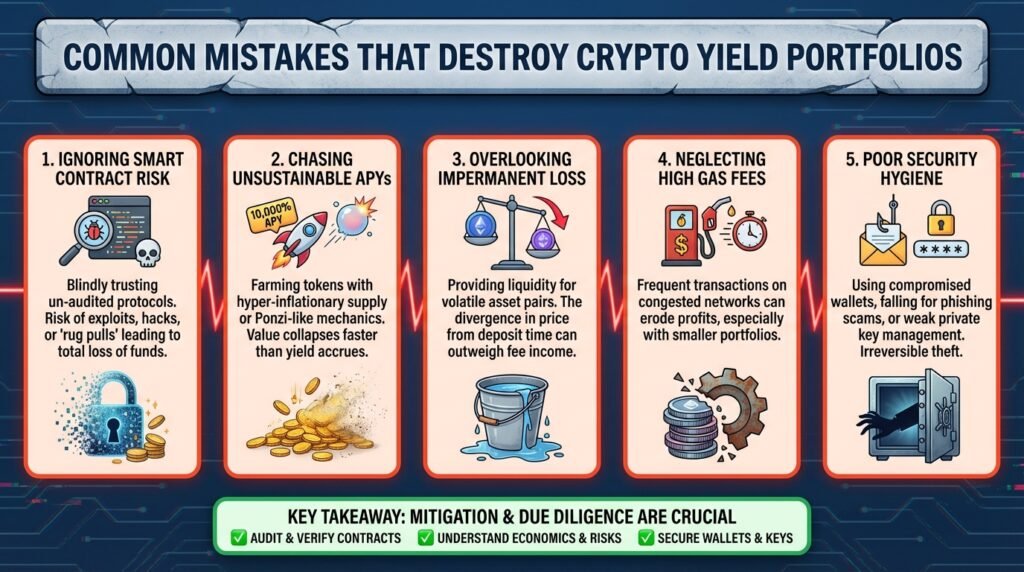
Consider these hard-won lessons from the broader community, presented here so you can avoid learning them the expensive way.
Chasing the highest advertised APY without questioning its source. If a protocol is showing 500% APY, the returns are almost certainly driven by inflationary token emissions, not real economic activity. These yields collapse as the token inflates and early participants exit.
Concentrating everything in a single protocol. The DeFi landscape is full of protocols that appeared unassailable until the day they were not. No individual protocol is too big to exploit.
Ignoring impermanent loss when calculating actual farming returns. The APY figure displayed on a farming interface does not subtract impermanent loss. A pool advertising 30% APY can deliver negative real returns when asset prices diverge significantly. Always calculate this independently.
Deploying capital you cannot afford to lose. Crypto volatility combined with strategy-specific risks means that capital in yield positions should represent your most risk-tolerant allocation. This is not investing 101, it is investing survival.
Forgetting transaction costs in your yield calculation. On Ethereum, gas fees can be substantial. A position that earns fifty dollars monthly in yield but costs forty dollars monthly in gas fees to manage is not the opportunity it appears to be on paper.
Failing to monitor positions regularly. DeFi positions are not savings accounts. Interest rates shift. Farming positions fall out of profitable price ranges. Protocols upgrade their mechanics. Set up alerts and review your positions consistently.
Using unaudited or brand-new protocols for meaningful capital. The yield exists on new, unaudited protocols precisely because the risk is extreme. The protocol needs to compensate users for taking on enormous uncertainty. Sometimes it works out. The majority of the time, it does not.
Frequently Asked Questions About Crypto Yield
Q: Is earning passive income from crypto actually safe?
It depends entirely on which strategies you use and how you manage risk. Staking well-established proof-of-stake assets through reputable liquid staking protocols is relatively low risk, though no crypto activity is completely without risk. Complex yield farming strategies on unaudited protocols carry substantially higher risk. The word “safe” in crypto always needs a qualifier.
Q: What is the most realistic starting APY for a beginner?
A beginner following a conservative approach (staking blue-chip assets and lending stablecoins on established protocols) can realistically expect between 4% and 10% APY. This is significantly higher than most traditional savings accounts while maintaining a manageable risk profile.
Q: How much crypto do I need to start earning yield?
There is no meaningful minimum for most DeFi strategies. You can stake as little as a few dollars worth of SOL or lend twenty dollars in USDC on Aave. However, transaction fees on networks like Ethereum make very small positions economically inefficient. Networks like Solana, Polygon, or Arbitrum have much lower fees and are more practical for smaller starting amounts.
Q: Is yield farming the same thing as staking?
No. Staking involves locking assets to support a blockchain network’s security and consensus mechanism, earning protocol-level rewards in return. Yield farming involves providing assets to DeFi protocols (most commonly as liquidity for trading pairs) and earning fees plus protocol incentives. The mechanics, risks, and yield sources are meaningfully different.
Q: What happened to all those CeFi lending platforms?
Several major centralized lending platforms collapsed during the 2022 bear market. Celsius Network, BlockFi, and Voyager Digital all either froze withdrawals or filed for bankruptcy after making risky bets with user deposits that went badly wrong. Users lost access to their funds for extended periods and in many cases recovered only a fraction of their deposits. This event highlighted the critical importance of understanding counterparty risk in centralized platforms.
Q: Can I lose more than I invest in a crypto yield strategy?
In non-leveraged strategies, your losses are capped at your initial investment. You cannot lose more than you put in. However, in leveraged yield strategies (where you borrow against your collateral to amplify returns), a sharp market move can result in liquidation of your collateral. This is why leverage requires exceptional caution.
Q: How do I report crypto yield on my taxes?
In most jurisdictions, yield received (whether staking rewards, farming tokens, or lending interest) is treated as ordinary income at the fair market value on the date of receipt. Any subsequent appreciation is subject to capital gains tax when you sell or trade. Use dedicated crypto tax software and consult a tax professional familiar with digital assets for your specific jurisdiction.
Q: What is the difference between APR and APY in crypto?
APR (Annual Percentage Rate) represents the simple interest rate without accounting for compounding. APY (Annual Percentage Yield) accounts for the effect of compounding. In crypto, most platforms display APY. When comparing opportunities across platforms, ensure you are comparing the same metric. A 15% APR compounded daily produces a higher real return than a 15% APR compounded monthly.
Q: Are stablecoins safe to use for yield farming?
This depends on which stablecoin. Fiat-backed stablecoins like USDC and USDT (while not without their own risks) have demonstrated relative stability over time. Algorithmic stablecoins, which maintain their peg through algorithmic mechanisms rather than real asset backing, have a much riskier track record. The collapse of UST in May 2022 wiped out tens of billions in value in a matter of days. Always understand how a stablecoin maintains its peg before using it.
Q: What is auto-compounding and should I use it?
Auto-compounding is the automatic reinvestment of earned rewards back into your yield position. Yield aggregators like Yearn Finance and Beefy Finance offer this service, often compounding multiple times per day. For active yield strategies, auto-compounding significantly improves long-term returns and eliminates the need to manually claim and reinvest rewards. The small platform fee charged is generally worth it for positions of meaningful size.
Crypto Yield Across Different Market Conditions
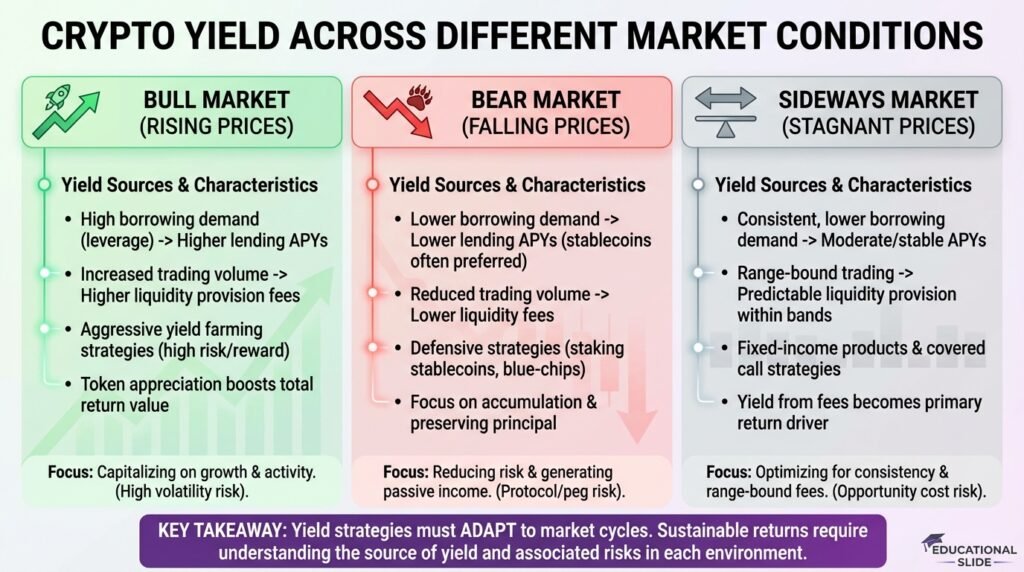
One of the most practical and underappreciated aspects of building a cryptoyield portfolio is understanding how different strategies perform across different market environments. Not all yield strategies behave the same way when crypto markets enter a bear cycle, and planning for this in advance is the difference between a resilient portfolio and one that falls apart when conditions turn against you.
During bull markets: Yield farming in volatile asset pairs becomes more attractive because trading volumes spike, fee income rises, and new protocol launches create abundant high-yield opportunities. However, impermanent loss risk also rises sharply as asset prices diverge. Staking and lending yields tend to increase as demand for borrowed capital grows with trader activity.
During bear markets: Stablecoin lending becomes relatively more attractive because it eliminates price exposure while still generating yield. Protocol token rewards collapse in value as token prices fall, so farming strategies that rely on token emissions become much less effective in real terms. Validators and stakers continue earning network-level rewards, but the fiat value of those rewards shrinks with asset prices.
During sideways markets: Concentrated liquidity provision on stable pairs tends to perform well in low-volatility environments. Fee income accumulates steadily without impermanent loss disrupting the position. Staking rewards accumulate without the emotional friction of a declining portfolio.
Adapting your strategy to the market cycle:
| Market Condition | Preferred Strategies | Strategies to Reduce | Key Focus |
|---|---|---|---|
| Bull market | Farming, volatile LP pairs, leveraged staking | Overconcentration in any one protocol | Take profits on governance token rewards |
| Bear market | Stablecoin lending, blue-chip staking | Leveraged positions, new protocol farming | Preserve capital, maintain liquidity |
| Sideways market | Stable pair LP, consistent staking | High-risk farming | Fee accumulation and compounding |
| High volatility | Reduce LP exposure, increase lending | Concentrated liquidity positions | Risk reduction |
Understanding this cycle-awareness does not mean trying to time the market precisely. It means structuring your portfolio so that some strategies perform in each environment, creating a yield portfolio that does not depend entirely on any single market condition to generate returns.
How to Evaluate a New Yield Opportunity Before Committing Capital
The crypto space generates new yield opportunities constantly. New protocols launch weekly. New strategies emerge on social media daily. The ability to evaluate these quickly and critically is one of the most valuable skills a yield investor can develop.
Here is a practical evaluation framework you can apply to any new opportunity before committing funds.
Step 1: Identify the actual yield source. Is this yield coming from real borrowing demand, trading fees, or real-world asset income? Or is it almost entirely driven by the protocol distributing its own tokens? If the answer is mostly token emissions, the next question is: what is the sustainable emission rate, and how long before inflation destroys the token’s value?
Step 2: Examine the protocol’s security posture. Has the smart contract code been audited by multiple reputable firms? How recently were those audits conducted? Has the protocol operated without an exploit? Is there an active bug bounty that incentivises researchers to find vulnerabilities before attackers do?
Step 3: Assess the team and governance. Is the team public and accountable? Does the protocol have meaningful community governance, or is control concentrated with the founding team? A protocol where a small group of wallets can unilaterally upgrade contracts and access treasury funds is a meaningful red flag regardless of how attractive the yield looks.
Step 4: Understand the withdrawal conditions. Can you exit the position freely and at any time? Are there lock-up periods, withdrawal fees, or conditions under which withdrawals could be paused? During the 2022 crisis, many users discovered that CeFi platforms had obscure terms allowing them to freeze withdrawals in adverse conditions.
Step 5: Calculate the realistic return including all costs. Headline APY figures rarely reflect the complete picture. Account for transaction fees, any platform fees deducted from rewards, impermanent loss exposure, and the likely depreciation of any governance tokens in the reward mix. The resulting number is your realistic expected return, and it is often significantly lower than the advertised figure.
Protocol evaluation scorecard:
| Evaluation Factor | Weight | What to Look For |
|---|---|---|
| Security audits | High | Multiple audits by reputable firms, no critical findings |
| Operational history | High | At least 12 months without exploit |
| Yield source transparency | High | Clearly explained and verifiable on-chain |
| Team transparency | Moderate | Public team with track record |
| Tokenomics | Moderate | Sustainable emission schedule, vesting for team tokens |
| Community governance | Moderate | Active and decentralized decision-making |
| Liquidity depth | Moderate | Sufficient TVL to absorb normal-sized positions |
| Exit conditions | High | Freely withdrawable with no unexpected restrictions |
The Future of Crypto Yield
The cryptoyield ecosystem is not static. Several developments are actively reshaping how passive income from crypto works, and understanding them positions you to take advantage of what comes next.
Real-World Asset tokenization is bringing traditional yield-generating instruments onto the blockchain. Government bonds, real estate income streams, private credit, and trade finance instruments are increasingly being tokenized and made accessible through DeFi protocols. This creates crypto yield backed by real-world cash flows rather than purely crypto-native mechanisms. The volume of real-world asset-backed products on-chain is growing every quarter, and projections from multiple research firms suggest this market could grow to trillions of dollars in value over the next decade.
Protocols operating in this space are creating a genuinely new asset class: the liquidity and accessibility of DeFi, combined with the cash flow reliability of traditional fixed-income instruments. For yield investors who want returns that are less correlated with crypto market cycles, real-world asset-backed products represent one of the most interesting developments in the space.
Cross-chain yield strategies are becoming more accessible as bridge infrastructure and multi-chain protocols mature. The ability to deploy capital across Ethereum, Solana, Arbitrum, Optimism, and other networks with minimal friction opens up a broader opportunity set and enables better risk diversification across networks with meaningfully different risk profiles.
Institutional DeFi is gradually becoming a reality as regulatory clarity improves and institutional-grade infrastructure develops. The entry of institutional capital into DeFi yield markets will deepen liquidity, potentially improve protocol security through more rigorous due diligence standards, and create a more stable ecosystem overall. When large, accountable institutions with fiduciary obligations begin participating in DeFi protocols, the incentive to maintain genuine security and transparency increases across the board.
Improved risk tooling is making the space meaningfully safer for sophisticated participants. Insurance protocols, improved auditing standards, formal verification of smart contract code, and on-chain credit scoring systems are all advancing simultaneously. These tools reduce the frequency and severity of the catastrophic failures that have characterized earlier DeFi development.
The fundamental opportunity, which is earning meaningful returns on digital assets through participation in decentralized financial infrastructure, is not going anywhere. The ecosystem is becoming more sophisticated, more diverse, and more accessible to a wider range of participants.
Your Complete Learning Map
This pillar page gives you the strategic overview and the map of the territory. Earning passive income from crypto effectively at a meaningful scale requires going deeper on each major topic. Here is how the rest of our content supports your journey:
Yield Farming Guide → Everything you need to understand liquidity pools, impermanent loss mechanics, protocol evaluation, and how to build a sustainable farming strategy without getting destroyed by volatility or exploits.
Crypto Staking Guide → The complete breakdown of proof-of-stake mechanics, validator selection, liquid staking protocols, reward calculation, slashing risk, and how to maximise staking returns safely across major networks.
Crypto Passive Income Guide → A broader view of every passive income strategy available in crypto, including approaches beyond staking and farming such as node operation, content monetization in Web3, and affiliate income within the crypto ecosystem.
Crypto Wallets and Security Guide → Everything you need to keep your assets safe, from choosing the right wallet type for your needs, to advanced multi-signature setups, secure seed phrase storage, recognizing phishing attempts, and responding to a security incident.
Crypto Basics Guide → The foundational knowledge that makes everything else make sense. Start here if you are new to crypto and want to build a real understanding of the ecosystem before committing any capital to yield strategies.
Final Thoughts
The most important reframe you can make about earning passive income from crypto is this: it requires active learning, not passive involvement.
The strategies are real. The yields are real. The risks are equally real. And the gap between those who build lasting, compounding crypto income and those who lose their capital to avoidable mistakes almost always comes down to one thing: the depth of understanding they brought to the table before deploying capital.
The people who have built durable crypto yield portfolios over multiple market cycles are not necessarily the ones who found the hottest protocol or took the most risk. They are the ones who understood what they owned, why it was generating returns, what could go wrong, and how to structure a portfolio resilient enough to survive the inevitable downturns that come with every market cycle.
The yield is real. The opportunity is real. The knowledge you have built through this guide is your most important asset in this space.Gain more knowledge here.
Pick one strategy that fits where you are today and learn it properly before moving to the next.
This content is produced for educational purposes only and does not constitute financial or investment advice. Crypto assets carry significant risk, including the risk of complete loss of capital. Conduct thorough independent research and consider consulting a qualified financial advisor before making any investment decisions.