
What Is Cryptocurrency? Complete Beginner Guide (2025)
If you’ve heard people talking about Bitcoin, Ethereum, or “crypto” and felt completely lost, you’re not alone. Cryptocurrency has become one of the most discussed topics in finance and technology, yet many people still don’t understand what it actually is or how it works.
This beginner crypto guide will answer the fundamental question: what is cryptocurrency? We’ll break down complex concepts into simple terms, explain how crypto works, and give you the foundation you need to understand this revolutionary technology.

Understanding What Cryptocurrency Really Means
At its core, cryptocurrency is digital money that exists only in electronic form. Unlike the dollars in your wallet or the coins in your pocket, you can’t physically hold cryptocurrency. It lives entirely on computer networks, secured by advanced mathematical encryption—which is where the “crypto” part of the name comes from.
But here’s what makes cryptocurrency fundamentally different from digital dollars in your bank account: no single person, company, or government controls it. Traditional money is managed by central banks and financial institutions. Cryptocurrency operates on decentralized networks maintained by thousands of computers worldwide.
Think of it this way: when you use your debit card, your bank processes the transaction and keeps records. With cryptocurrency, the network itself verifies transactions through a system where no single entity has complete control. This decentralization is the revolutionary aspect that has captured global attention.
The Birth of Cryptocurrency: How It All Started
To truly understand what is cryptocurrency, we need to look at its origin. In 2008, an anonymous person (or group) using the name Satoshi Nakamoto published a whitepaper describing Bitcoin—the world’s first cryptocurrency.
Nakamoto’s vision was simple yet radical: create a form of money that could be transferred directly between people without banks or payment processors acting as middlemen. The goal was to give individuals full control over their money while maintaining security and preventing fraud.
Bitcoin launched in January 2009, and the first real-world transaction happened in 2010 when someone famously paid 10,000 Bitcoin for two pizzas (those Bitcoin would be worth hundreds of millions today). Since then, thousands of different cryptocurrencies have been created, each with unique features and purposes.
How Crypto Works: The Technology Behind Digital Currency
Now that we’ve covered what is cryptocurrency in simple terms, let’s explore the technology that makes it possible. Understanding how crypto works requires learning about blockchain—the underlying system that powers most cryptocurrencies.
Blockchain: The Foundation of Cryptocurrency
Imagine a notebook where every transaction is recorded. Now imagine this notebook is copied and distributed to thousands of computers around the world. Whenever someone makes a transaction, all copies of the notebook are updated simultaneously. That’s essentially how blockchain works.
A blockchain is a digital ledger—a record-keeping system—that stores transaction information in “blocks.” Each block contains:
- Transaction details (who sent what to whom)
- A timestamp showing when it happened
- A unique code linking it to the previous block
Once a block is filled with transactions, it’s sealed and permanently linked to the chain of previous blocks. This creates an unbreakable, chronological record of every transaction that’s ever occurred.
Why Blockchain Makes Cryptocurrency Secure
The genius of blockchain technology lies in its security features. Because thousands of computers hold identical copies of the transaction record, no single person can alter the history. If someone tried to change their copy, all other copies would contradict it, and the network would reject the fraudulent version.
This system eliminates the need for a trusted middleman. You don’t need a bank to verify that you have enough money to complete a transaction—the entire network can verify it by checking the blockchain.
Mining and Validation: How Transactions Get Confirmed
When you send cryptocurrency, the transaction doesn’t happen instantly. It needs to be verified and added to the blockchain. This is where “miners” come in.
Miners are people (or more accurately, their powerful computers) who compete to solve complex mathematical puzzles. The first to solve the puzzle gets to add the next block of transactions to the blockchain and receives newly created cryptocurrency as a reward. This process is called “mining.”
This might sound complicated, but from a user’s perspective, it’s simple: you send cryptocurrency, wait a few minutes for miners to confirm it, and the recipient receives it. The technical complexity happens behind the scenes.
Cryptocurrency Explained: Key Features That Make It Unique
To fully grasp what is cryptocurrency and why it matters, you need to understand its defining characteristics:
Decentralization
No government, bank, or company controls cryptocurrency networks. They’re maintained by distributed networks of participants worldwide. This means no single entity can freeze your account, reverse transactions without your permission, or manipulate the supply arbitrarily.
Transparency
All transactions are recorded on the public blockchain. Anyone can view the complete transaction history, which creates unprecedented transparency. However, transactions are pseudonymous—you can see that a transaction occurred, but not necessarily who made it.
Security
Cryptocurrency uses cryptographic techniques to secure transactions and control the creation of new units. Your cryptocurrency is protected by complex mathematical codes that are virtually impossible to crack with current technology.
Limited Supply
Most cryptocurrencies have a fixed maximum supply. Bitcoin, for example, will never have more than 21 million coins. This scarcity differs from traditional currencies, where central banks can print more money, potentially causing inflation.
Borderless Transactions
You can send cryptocurrency anywhere in the world as easily as sending an email. There are no international wire fees, no currency exchange complications, and no banks refusing transfers to certain countries.
Speed and Accessibility
Cryptocurrency transactions can happen 24/7, including weekends and holidays. Traditional banking systems close, but cryptocurrency networks never sleep. Transactions often settle in minutes rather than the days required for international bank transfers.
Types of Cryptocurrency: Beyond Bitcoin
When people ask what is cryptocurrency, they often think only of Bitcoin. However, the cryptocurrency ecosystem has expanded dramatically. Here are the main categories:
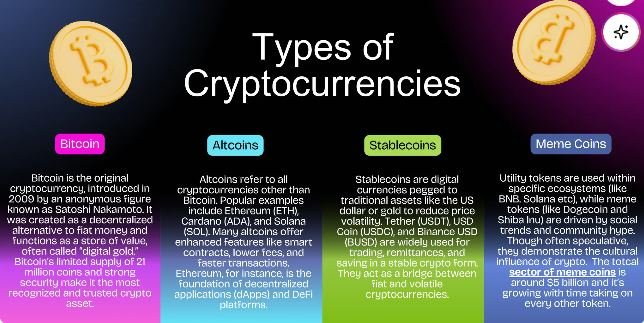
Bitcoin (BTC)
The original cryptocurrency remains the largest by market value. Bitcoin is primarily seen as “digital gold”—a store of value and hedge against inflation rather than everyday spending money.
Ethereum (ETH)
The second-largest cryptocurrency isn’t just digital money. Ethereum is a platform for building decentralized applications and “smart contracts”—self-executing agreements coded into the blockchain.
Stablecoins
These cryptocurrencies are designed to maintain a stable value, usually by being backed by traditional currency like the US dollar. Examples include USDT and USDC, which aim to stay at $1 per coin.
Altcoins
This term covers all cryptocurrencies other than Bitcoin. There are thousands of altcoins, each trying to improve on Bitcoin’s model or serve specific purposes—from privacy-focused coins to those designed for fast payments.
Utility Tokens
These give holders access to specific services or applications. They’re like digital arcade tokens that work within particular cryptocurrency ecosystems.
How Cryptocurrency Gets Its Value
A common question in any beginner crypto guide is: if cryptocurrency isn’t backed by gold or governments, where does its value come from?
Cryptocurrency value comes from several factors:
Supply and Demand: Like any asset, when more people want to buy than sell, the price increases. Limited supply (like Bitcoin’s 21 million cap) creates scarcity.
Utility: Cryptocurrencies that solve real problems or enable useful applications tend to hold value. Ethereum’s ability to run smart contracts, for example, gives it practical utility.
Network Effect: The more people use a cryptocurrency, the more valuable it becomes. Bitcoin’s widespread recognition and acceptance contribute significantly to its value.
Security and Trust: Established cryptocurrencies with proven security records and reliable networks command higher values than new, untested projects.
Speculation: Like stocks, some cryptocurrency value comes from speculation about future potential. This can cause dramatic price swings.
Real-World Uses of Cryptocurrency Today
Understanding what is cryptocurrency becomes clearer when you see how people actually use it:
Investment: Many people buy cryptocurrency hoping it will increase in value over time, similar to investing in stocks or gold.
International Remittances: Workers sending money home to families in other countries can save significantly on fees by using cryptocurrency instead of traditional money transfer services.
Online Purchases: A growing number of retailers accept cryptocurrency as payment, from major corporations to small online shops.
Decentralized Finance (DeFi): People can lend, borrow, and earn interest on cryptocurrency without traditional banks through decentralized platforms.
Digital Ownership: Non-fungible tokens (NFTs) use cryptocurrency blockchain technology to prove ownership of digital art, collectibles, and other assets.
Privacy: Some cryptocurrencies offer enhanced privacy features for those concerned about financial surveillance.
Risks and Considerations: The Other Side of Cryptocurrency
Any honest cryptocurrency explained guide must address the risks:
Volatility: Cryptocurrency prices can swing wildly. Bitcoin has experienced drops of 50% or more multiple times. This volatility makes it risky for those who can’t afford losses.
Security Responsibility: With cryptocurrency, you’re your own bank. If you lose your access codes or fall for a scam, there’s often no way to recover your funds.
Regulatory Uncertainty: Governments worldwide are still figuring out how to regulate cryptocurrency. Laws can change, potentially affecting value and usability.
Scams and Fraud: The cryptocurrency space attracts scammers promoting fake projects or Ponzi schemes. Due diligence is essential.
Technical Complexity: While improving, using cryptocurrency still requires more technical knowledge than traditional banking.
Irreversible Transactions: Once confirmed, cryptocurrency transactions cannot be reversed. Send to the wrong address, and your funds are likely gone forever.
Getting Started with Cryptocurrency: First Steps
If this beginner crypto guide has sparked your interest, here’s how to begin:
Educate Yourself: Continue learning about how crypto works before investing money. Understanding the technology and risks is crucial.
Start Small: Only invest what you can afford to lose completely. Cryptocurrency should be a small part of a diversified investment portfolio.
Choose a Reputable Exchange: Platforms like Coinbase, Binance, or Kraken allow you to buy cryptocurrency with traditional money. Research options and choose established, regulated platforms.
Set Up a Secure Wallet: Decide whether to keep cryptocurrency on the exchange (convenient but less secure) or transfer it to a personal wallet (more secure but requires more technical knowledge).
Make Your First Purchase: Start with small amounts to understand the process before committing significant funds.
Practice Security: Enable two-factor authentication, use strong passwords, never share your private keys, and be skeptical of anything promising guaranteed returns.
The Future of Cryptocurrency: What’s Next?
Understanding what is cryptocurrency also means considering where it’s heading. Several trends are shaping the future:
Institutional Adoption: Major companies and financial institutions are increasingly incorporating cryptocurrency into their operations and investment portfolios.
Regulatory Clarity: As regulations develop, cryptocurrency may become more mainstream and accessible while losing some of its “Wild West” characteristics.
Technological Improvements: New developments are addressing current limitations like transaction speed, energy consumption, and user-friendliness.
Central Bank Digital Currencies (CBDCs): Many countries are exploring government-issued digital currencies, which could legitimize the concept while potentially competing with decentralized cryptocurrencies.
Integration with Traditional Finance: The line between traditional banking and cryptocurrency is blurring as conventional financial institutions offer crypto-related services.
Final Thoughts: Is Cryptocurrency Right for You?
Now that we’ve thoroughly explored what is cryptocurrency, how crypto works, and what it means in practical terms, you can make more informed decisions about whether to get involved.
Cryptocurrency represents a genuine technological innovation with the potential to reshape finance. However, it’s not without risks and isn’t suitable for everyone. The key is approaching it with realistic expectations, thorough understanding, and appropriate caution.
Whether you choose to invest, use cryptocurrency for transactions, or simply stay informed about this evolving technology, understanding the fundamentals covered in this beginner crypto guide gives you a solid foundation.
The world of cryptocurrency explained can seem overwhelming at first, but like learning any new technology, it becomes clearer with time and continued education. Start slowly, keep learning, and never invest more than you can afford to lose.
Continue Your Cryptocurrency Education
Ready to dive deeper? Explore our other comprehensive guides:
- What is Cryptocurrency: Beginners Guide
- Cryptocurrency Wallets Explained: Hot vs. Cold Storage
- Understanding Blockchain Technology Beyond Bitcoin
- Crypto Safety: Essential Security Practices for Beginners
- Top 10 Cryptocurrencies to Know in 2025
Have questions about what is cryptocurrency or how crypto works? Visit our FAQ section or contact our team. We’re here to make cryptocurrency accessible and understandable for everyone.
Disclaimer: This article is for educational purposes only and does not constitute financial advice. Cryptocurrency investment carries substantial risk. Always conduct your own research and consult with qualified financial professionals before making investment decisions.
You can also learn What is blockchain and Crypto investment
Get more authentic information about Cryptocurrency at Crypto At Your Choice