The cryptocurrency landscape has matured significantly since the DeFi summer of 2020, and yield farming has evolved from a Wild West experiment into a sophisticated financial strategy. What started as simple liquidity provision has transformed into a complex ecosystem of opportunities, risks, and innovations that demand careful understanding before diving in.
This comprehensive guide will walk you through everything you need to know about yield farming in 2026, from fundamental concepts to advanced strategies that can help you maximize returns while managing risk effectively.
Understanding Yield Farming in 2026
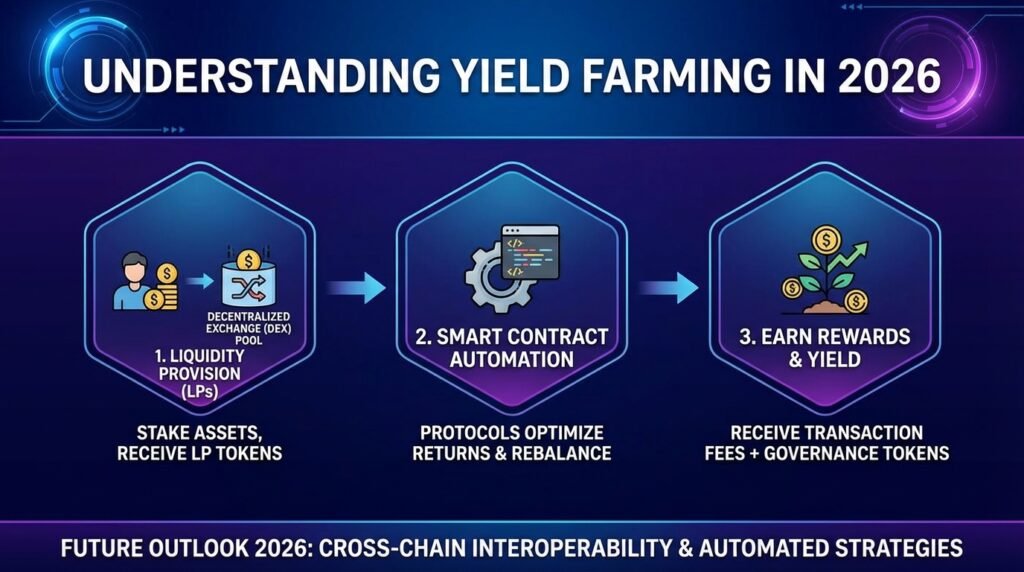
Yield farming has come a long way from its chaotic beginnings. Today, it represents a mature approach to generating passive income in the decentralized finance ecosystem. At its core, yield farming involves putting your cryptocurrency assets to work by providing liquidity to DeFi protocols in exchange for rewards.
Think of it as being a market maker in traditional finance, but democratized and accessible to anyone with a crypto wallet. You’re essentially becoming the infrastructure that enables others to trade, borrow, and lend digital assets. In return, you earn fees and often additional token rewards.
The landscape has shifted dramatically following what we now call the “liquidity wars” era. Protocols no longer compete solely on astronomical APYs that proved unsustainable. Instead, they focus on sustainable yield generation, protocol revenue sharing, and creating genuine value for liquidity providers. The days of 10,000% APYs from inflationary farming tokens are mostly behind us, replaced by more realistic yields backed by actual protocol revenue.
Modern yield farming has also become significantly more sophisticated. We’re seeing concentrated liquidity positions, automated strategy vaults, cross-chain yield optimization, and complex multi-step strategies that would have been impossible just a few years ago.You can also learn about Yield Farming.
Yield Farming vs. Staking: Critical Differences
Many newcomers confuse yield farming with staking, but they’re fundamentally different activities with distinct risk profiles and reward mechanisms.
Staking involves locking up tokens to help secure a proof-of-stake blockchain. When you stake ETH on Ethereum, for example, you’re participating in network validation and earning rewards for helping maintain blockchain security. Your returns come from protocol inflation and transaction fees, and your primary risk is slashing if you run a validator improperly.
Yield farming, by contrast, involves providing liquidity to decentralized exchanges or lending protocols. You’re depositing token pairs into liquidity pools where traders can swap between them. Your returns come from trading fees, borrowing interest, and often additional token incentives. The risk profile is entirely different, involving impermanent loss, smart contract vulnerabilities, and market volatility.
Staking is generally more passive and straightforward. You lock tokens, run a validator or delegate to one, and earn predictable yields. Yield farming requires active management, understanding of liquidity dynamics, and constant monitoring of positions.
The capital efficiency also differs dramatically. Staking typically requires full token lockup with limited flexibility. Yield farming can involve leverage, where you borrow assets to increase your farming position, amplifying both potential returns and risks.
Returns tell a similar story of divergence. Staking yields on major networks like Ethereum hover around 3% to 5%, relatively stable and predictable. Yield farming returns vary wildly, from 5% to 50% or more, depending on the platform, strategy, and risk tolerance.
Top Yield Farming Platforms in 2026
The platform landscape has consolidated around proven, audited protocols while new innovations continue emerging on layer 2 networks and cross-chain infrastructure.
Uniswap V3 and V4
Uniswap remains the gold standard for decentralized exchange liquidity provision. Version 3 revolutionized the space with concentrated liquidity, allowing you to provide liquidity within specific price ranges. Instead of spreading your capital across the entire price curve, you can concentrate it where trading actually happens, dramatically improving capital efficiency.
The catch is complexity. Managing a Uniswap V3 position requires understanding price ranges, fee tiers, and active rebalancing. When prices move outside your chosen range, you stop earning fees entirely. This has spawned an entire ecosystem of automated managers like Gamma and Arrakis that handle the complexity for you in exchange for performance fees.
Uniswap V4 has introduced hooks, programmable modules that allow pools to implement custom logic. This enables sophisticated strategies like dynamic fee adjustment, MEV protection, and automated rebalancing directly at the protocol level. Early adopters are finding creative ways to optimize yields using these new capabilities.
Typical yields on Uniswap vary by pair and fee tier. Stablecoin pairs might earn 5% to 15% with lower volatility risk. ETH/WBTC pairs often yield 10% to 25% with moderate impermanent loss exposure. Exotic pairs can exceed 40% but come with substantial risk of one token collapsing.
Aave V3
Aave has evolved from a simple lending protocol into a comprehensive DeFi hub. As a yield farmer, you can supply assets to earn interest from borrowers, with additional AAVE token rewards in some markets.
The genius of Aave for yield farming is its cross-chain portal functionality and isolation mode. You can supply assets on one chain and borrow on another, optimizing for the best rates across multiple networks. Isolation mode allows newer, riskier assets to be listed without endangering the entire protocol.
Aave’s e-mode (efficiency mode) is particularly powerful for correlated assets. When providing stablecoins or ETH derivatives, you can achieve much higher capital efficiency with lower collateralization requirements. This enables leverage strategies that weren’t previously possible.
Yields on Aave are typically more conservative than DEX farming, ranging from 2% to 8% on stablecoin deposits and 1% to 5% on major crypto assets. The real opportunity comes from recursive strategies, where you deposit, borrow, redeposit in a loop to amplify your exposure and rewards.
Curve Finance
Curve dominates the stablecoin and pegged asset space. Its specialized automated market maker design minimizes slippage for similar assets, making it ideal for stablecoin swaps and wrapped asset trading.
The Curve ecosystem is complex but rewarding. You provide liquidity to Curve pools to earn trading fees, then stake your LP tokens on Curve to earn CRV rewards, then lock CRV as veCRV to boost your rewards by up to 2.5x and earn protocol revenue sharing. It’s a multi-layered system that rewards long-term participants.
Recent innovations include crvUSD, Curve’s native stablecoin backed by user collateral. Minting crvUSD opens new yield farming strategies, where you can use volatile assets as collateral to mint stablecoins, then farm with those stablecoins for leveraged exposure.
Curve yields are generally sustainable and backed by real trading volume. Stablecoin pools typically yield 3% to 12%, while more exotic pools can exceed 20%. The addition of convex and other vote locking protocols adds another layer of yield optimization.
Layer 2 and Cross-Chain Platforms
The future of yield farming is increasingly multi-chain. Arbitrum, Optimism, Base, and other layer 2 networks offer significantly lower transaction costs, making active farming strategies economically viable even for smaller portfolios.
Protocols like Velodrome on Optimism and Aerodrome on Base have reimagined the Curve model with vote-escrowed tokenomics optimized for their respective ecosystems. These platforms offer compelling yields, often 20% to 60% on major pairs, subsidized by protocol emissions and boosted by locked voting power.
Cross-chain yield aggregators like Beefy Finance have expanded across dozens of networks, offering auto-compounding vaults that harvest rewards and reinvest them automatically. This solves the manual compounding problem and makes yield farming more passive.
The emergence of proper cross-chain bridges and messaging protocols like LayerZero has enabled truly unified liquidity strategies. You can now farm on multiple chains simultaneously, rebalancing between them based on yield opportunities without manually bridging assets.
Step by Step Setup for Yield Farming
Getting started with yield farming requires careful preparation and understanding of the infrastructure involved.
Wallet Setup and Security
Your wallet is the foundation of everything. Hardware wallets like Ledger or Trezor provide the best security for significant capital. These devices keep your private keys offline and require physical confirmation for transactions.
For active farming involving frequent transactions, many users maintain a hot wallet for operations while keeping the bulk of funds in cold storage. MetaMask remains the most popular hot wallet, but alternatives like Rabby and Rainbow offer improved multi-chain support and better transaction simulation.
Security practices are non-negotiable. Enable all available security features, never share your seed phrase, and be extraordinarily skeptical of any website asking you to connect your wallet. The number one cause of fund loss in DeFi is phishing attacks and malicious contract approvals.
Create separate wallet addresses for different activities. One wallet for large holdings in cold storage, another for active farming, and perhaps a third for experimenting with new protocols. This compartmentalization limits damage if one wallet is compromised.
Choosing Your First Position
Start with battle-tested protocols and relatively stable asset pairs. A stablecoin pair like USDC/USDT on Curve is an excellent first position. You avoid impermanent loss almost entirely while learning the mechanics of depositing, monitoring, and withdrawing.
Consider your capital base realistically. On Ethereum mainnet, gas fees can easily reach $20 to $50 per transaction during busy periods. If you’re farming with $1,000, these fees will destroy your returns. Start on layer 2 networks where transaction costs are under $1.
Evaluate the yield source critically. Is it coming from trading fees, lending interest, or token emissions? Sustainable yields come from actual protocol revenue. Extremely high yields from token emissions are temporary by nature and often collapse as emissions decrease or token prices fall.
Diversify across protocols and strategies from the beginning. Putting all your capital in one pool exposes you to that specific protocol’s risks. Spreading across three to five different positions reduces concentration risk while still maintaining manageable complexity.
Executing Your First Deposit
The actual process is more straightforward than it might seem. We’ll walk through depositing into a Curve stablecoin pool as an example.
First, acquire the necessary tokens. For a 3pool position on Curve, you need some combination of USDC, USDT, and DAI. You can deposit with just one token, but the pool will automatically balance it, sometimes resulting in slight slippage.
Navigate to the Curve Finance interface and connect your wallet. Find the 3pool and select deposit. Enter the amount of each stablecoin you want to deposit. The interface will show you exactly how many LP tokens you’ll receive, representing your share of the pool.
Review the transaction carefully before confirming. Check that you’re interacting with the correct contract address. Curve will show the contract address, and you can verify it against the official documentation. Approve the spending of your tokens if this is your first time, then execute the deposit.
Once confirmed, you’ll see LP tokens in your wallet. But you’re not done yet. To earn CRV rewards, you need to stake these LP tokens. Navigate to the staking section of Curve, find your pool, and stake your LP tokens. This second transaction enables you to earn additional rewards beyond trading fees.
Setting Up Auto-Compounding
Manual compounding means regularly claiming your rewards and reinvesting them into your position. With gas fees, this can quickly become expensive and time-consuming. Auto-compounding vaults solve this problem.
Platforms like Yearn Finance and Beefy Finance offer vaults that automatically harvest and reinvest your rewards. Instead of depositing directly into Curve, you deposit into a Yearn vault that deposits into Curve for you. The vault regularly claims CRV rewards, sells them, and reinvests into more LP tokens.
The tradeoff is fees. Auto-compounding vaults typically charge 2% to 5% of the additional yield generated or a small percentage of assets under management. For larger positions, this is absolutely worth it. For smaller positions, it’s often essential just to make the math work after gas costs.
Evaluate vault performance history. Established vaults have track records showing how they’ve performed during different market conditions. Newer vaults might offer higher rates but carry additional smart contract risk.
Real APY Examples and Yield Calculations
Understanding the difference between APY and APR is crucial, as is learning to calculate your real returns after costs.
APR (Annual Percentage Rate) is the simple interest rate without compounding. If a pool offers 20% APR and you invest $10,000, you’d earn $2,000 over a year if you never reinvested your rewards.
APY (Annual Percentage Yield) accounts for compounding. That same 20% APR, if compounded daily, becomes approximately 22.13% APY. The more frequently you compound, the higher your effective yield.
Let’s examine real examples from current 2026 conditions:
Conservative Strategy: Curve 3pool
Base trading fee APR of 1.5%, CRV rewards APR of 4%, veCRV boost multiplier of 2.5x on rewards results in a total yield of about 11.5% APY after compounding. With a $50,000 position, this generates approximately $5,750 annually. Transaction costs on Ethereum mainnet might eat $500 to $1,000 yearly from claiming and compounding, while an auto-compounder charges around $175 in performance fees. Your net return is approximately $5,075, or 10.15% real yield.
Moderate Strategy: Uniswap V3 ETH/USDC 0.3% Fee Tier
Trading fees average 18% APR on concentrated position, no token emissions but higher capital efficiency. A well-managed $50,000 position yields roughly $9,000 annually. However, impermanent loss from ETH price movements averages about 3% to 8% annually depending on volatility. Transaction costs for rebalancing every two weeks run approximately $800 yearly on layer 2. After a 1.5% position management fee from an automated manager, your net return ranges from $6,500 to $7,800, or 13% to 15.6% real yield.
Aggressive Strategy: Velodrome Volatile Pair with Vote Locking
Base trading fees of 15% APR, VELO emissions of 35% APR, and vote locking boost of 1.8x on emissions yields approximately 78% APY before compounding. A $50,000 position generates about $39,000 nominally. Impermanent loss on volatile pairs averages 12% to 20% annually, immediately reducing real gains to $19,000 to $27,000. The VELO tokens you earn may depreciate 30% to 50% over the year as emissions inflate supply, cutting real value further. After accounting for all factors, real returns land around 15% to 25%, comparable to the moderate strategy but with far higher risk and volatility.
These examples illustrate a critical truth about yield farming. Advertised rates are often misleading. Your real returns depend on compounding frequency, transaction costs, token price movements, and impermanent loss, none of which appear in the headline APY.
Understanding and Mitigating Impermanent Loss
Impermanent loss is the most misunderstood concept in yield farming, yet it’s absolutely critical to grasp before deploying meaningful capital.
The Mathematics of Impermanent Loss
Impermanent loss occurs when the price ratio of tokens in your liquidity pool changes compared to when you deposited. If you’d simply held the tokens, you would have more value than remaining in the pool.
Here’s why this happens. Automated market makers maintain constant product formulas. When prices change, arbitrageurs trade against your pool to rebalance it, effectively selling your appreciating asset and buying your depreciating one automatically.
Let’s make this concrete with numbers. You deposit 1 ETH and 2,000 USDC into a pool when ETH is worth $2,000. Your total value is $4,000, and the pool contains equal dollar values of each token.
ETH doubles to $4,000. If you’d held your original tokens, you’d have 1 ETH worth $4,000 plus 2,000 USDC, totaling $6,000. But in the pool, arbitrageurs have automatically rebalanced it. The constant product formula means you now have approximately 0.707 ETH and 2,828 USDC, totaling $5,656.
Your impermanent loss is $344, or 5.7%. You still gained value overall, just less than simply holding. This is why it’s “impermanent.” If prices return to the original ratio, the loss disappears.
The mathematics become more extreme with larger price movements. A 2x price change results in 5.7% impermanent loss. A 3x change results in 13.4% loss. A 5x change results in 25.5% loss. A 10x change results in 42.9% loss.
Strategies to Reduce Impermanent Loss
Choosing correlated assets is the most effective mitigation strategy. Stablecoin pairs experience virtually no impermanent loss since prices stay aligned. ETH/stETH or wBTC/tBTC pairs are similarly protected since these assets track each other.
Concentrated liquidity on Uniswap V3 actually increases impermanent loss risk within your range, but you can set ranges that anticipate price movements. If you expect ETH to appreciate, set your range above current prices. You’ll earn fees as prices rise through your range while reducing divergence loss.
Single-sided staking avoids impermanent loss entirely but usually offers lower yields. Platforms like Tokemak pioneered this approach, where you stake single assets and the protocol uses them for liquidity provision, absorbing the impermanent loss risk itself in exchange for lower yields paid to depositors.
Hedging strategies involve taking offsetting positions. You might farm an ETH/USDC pair while holding a short ETH position on a perpetual futures exchange. The futures loss offsets impermanent loss, though this adds complexity and additional costs.
Some protocols now offer impermanent loss insurance or protection. Bancor pioneered this with 100% impermanent loss protection after 100 days, though they later suspended this during market stress, highlighting the challenges of such systems. Newer protocols like Gamma offer partial protection through asymmetric fee structures.
The most important mitigation is realistic expectations. Don’t farm volatile pairs expecting both high yields and no impermanent loss. Understand that you’re making a calculated tradeoff, accepting impermanent loss risk in exchange for trading fees and token rewards that hopefully exceed it.
Smart Contract Risks and Protocol Security
The DeFi space has matured significantly in terms of security, but smart contract risk remains the elephant in the room that can instantly wipe out your entire position.

Understanding the Risk Landscape
Smart contracts are immutable code managing billions of dollars. Any bug or vulnerability can be exploited, often within minutes of discovery. Unlike traditional finance, there’s no bank that can reverse fraudulent transactions or insurance that reliably covers your losses.
The risk isn’t theoretical. Major protocols have suffered devastating exploits. Poly Network lost $600 million in 2021. Wormhole bridge lost $320 million in 2022. Euler Finance lost $200 million in 2023. Each year brings new sophisticated attacks.
Contract complexity compounds risk exponentially. A simple staking contract might have been audited thoroughly and run for years without incident. But yield farming often involves multiple contract interactions, each introducing potential failure points. When you deposit into a vault that deposits into Aave, which borrows on Compound, which farms on Curve, you’re exposed to vulnerabilities in every protocol in that chain.
Evaluating Protocol Safety
Start with protocol age and track record. Aave, Curve, and Uniswap have operated for years processing hundreds of billions in volume. They’ve been stress tested by the market, scrutinized by thousands of security researchers, and proven resilient. New protocols launching with immediately high TVL and aggressive yields should raise red flags.
Audit history matters enormously. Check whether the protocol has been audited by reputable firms like Trail of Bits, OpenZeppelin, or ConsenSys Diligence. Multiple audits from different firms provide better coverage. But understand that audits aren’t guarantees. Audited protocols still get exploited when auditors miss something or new code gets deployed without auditing.
Bug bounties signal serious security commitment. Protocols offering $1 million or more for critical bug discoveries are investing seriously in security. Immunefi maintains a leaderboard of bug bounty programs, useful for comparing protocols.
Time locks on contract upgrades provide crucial safety. If admin keys can instantly upgrade contracts, a compromised admin wallet means instant catastrophe. Protocols implementing 24 to 48 hour time locks on upgrades give users time to exit if malicious changes are proposed.
Community governance reduces single points of failure. Protocols controlled by multi-signature wallets requiring multiple parties to sign off on changes are safer than those with single admin keys.
Insurance Options
DeFi insurance has emerged as a partial solution, though it’s far from comprehensive. Nexus Mutual offers coverage against smart contract failures, where you purchase cover for specific protocols for specific time periods. If an exploit occurs and Nexus assessors agree it qualifies, you receive a payout.
The challenge is cost and coverage limits. Protecting $100,000 of deposits might cost $2,000 to $5,000 annually for comprehensive coverage, significantly reducing your net yield. Coverage is also capped, and during major events, insurance protocols themselves face solvency questions.
Alternative risk management involves diversification across protocols. Instead of deploying $200,000 into one Curve pool, split it across Curve, Aave, Uniswap, and others. A catastrophic failure of one protocol costs you 25% rather than everything.
Tax Implications of Yield Farming
Tax treatment of yield farming is complex and varies by jurisdiction, but understanding the basics can save you from nasty surprises.
Income vs. Capital Gains
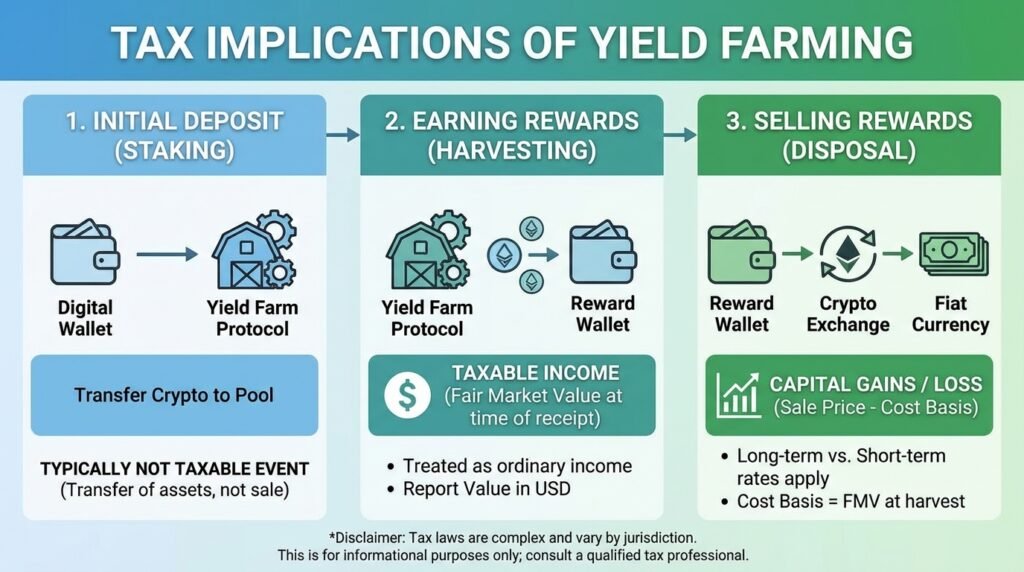
In most jurisdictions including the United States, rewards from yield farming are generally treated as ordinary income at the time you receive them, valued at their fair market value when received.
This has significant implications. If you earn 100 CRV tokens worth $100 when you claim them, that’s $100 of taxable income. It doesn’t matter if you immediately reinvest them or hold them. The IRS considers you to have received income the moment tokens hit your wallet.
When you later sell those CRV tokens, you have a capital gain or loss. Your cost basis is the value when you originally received them as income. If they increased to $150, you have a $50 capital gain. If they decreased to $75, you have a $25 capital loss.
This creates potential for double taxation that feels unfair but is legal. You pay ordinary income tax on the $100 value when received, then capital gains tax on any appreciation, or get a capital loss deduction on any depreciation.
LP Tokens and Dispositions
Tax treatment of providing liquidity is even more complex. Some tax professionals argue that depositing tokens into a liquidity pool is a taxable event because you’re disposing of your tokens in exchange for LP tokens. Others argue it’s non-taxable because you maintain beneficial ownership through the LP tokens.
The conservative approach treats LP token creation as a taxable disposition. If you bought ETH for $1,500 and deposit it into a pool when it’s worth $2,000, you’ve realized a $500 capital gain, even though you haven’t cashed out to fiat.
Withdrawing liquidity is almost certainly taxable. You’re disposing of LP tokens in exchange for the underlying tokens. Your gain or loss is based on the difference between what you paid for the LP tokens (or their value when you received them) and their value when redeemed.
Impermanent loss creates a fascinating tax situation. If you withdraw liquidity and have less value than you started with, even after accounting for earned fees, is that a deductible loss? Current guidance is unclear, and different tax professionals give different advice.
Record Keeping Essentials
Meticulous record keeping isn’t optional if you want to avoid problems. Every transaction must be documented, including the date, time, tokens involved, quantities, dollar values, gas fees, and purpose.
Cryptocurrency tax software like Koinly, CoinTracker, or TokenTax can help, but they’re not perfect. These tools connect to your wallets and exchanges to import transactions automatically, then calculate your gains, losses, and income. However, they often misclassify complex DeFi transactions.
Manual review is essential. Go through your transaction history and ensure everything is categorized correctly. A liquidity provision might be miscategorized as a sale. Reward claims might not be captured as income.
Save documentation of everything. Screenshots of platforms showing your positions, dates, and values. Transaction hashes from the blockchain. Correspondence with tax professionals about treatment of specific transactions. If you’re ever audited, you’ll need to prove everything.
Working with Tax Professionals
Finding a tax professional who understands cryptocurrency is crucial if you’re doing serious yield farming. Traditional accountants often don’t grasp the nuances of DeFi transactions.
Look for CPAs or enrolled agents who specialize in cryptocurrency taxation. Organizations like the American Institute of CPAs have digital asset resource panels. Online communities can recommend professionals with proven expertise.
Be proactive about planning. Meet with your tax professional before year end to understand your current tax situation and potentially make strategic moves. Perhaps you have significant income this year and want to defer some reward claims to next year. Maybe you have capital losses you can harvest to offset gains.
Consider the total tax burden when evaluating yields. A 30% APY sounds amazing, but if you’re paying 37% federal tax plus state tax on those rewards as ordinary income, your after-tax return might be only 17% to 20%. A lower-yield strategy producing long-term capital gains taxed at 15% might actually be better.
Sustainable vs. High Risk Strategies
Not all yield farming is created equal. Understanding where yields come from and evaluating sustainability is crucial for long-term success.
Characteristics of Sustainable Yields
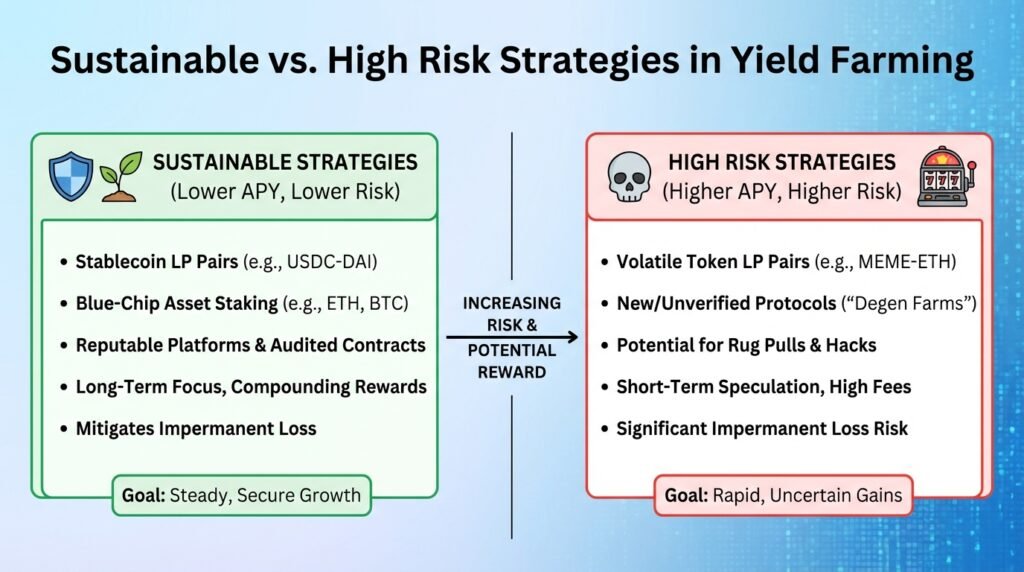
Sustainable yields are backed by real protocol revenue. Trading fees from actual user activity, interest from genuine borrowing demand, and protocol-owned revenue sources create yields that can persist indefinitely.
Curve’s base yields from trading fees exemplify this. As long as people need to swap stablecoins and trade wrapped assets, Curve pools will generate fees for liquidity providers. The yield might fluctuate with trading volumes, but it won’t suddenly disappear.
Aave’s lending yields similarly derive from sustainable sources. Borrowing demand creates interest payments to lenders. During bull markets when leverage demand is high, rates increase. During bear markets, they decrease. But the fundamental mechanism persists.
Reasonable yield expectations are another hallmark of sustainability. Stablecoin pools rarely sustainably yield more than 8% to 15%. ETH/wBTC pairs might reach 15% to 25%. Higher rates usually indicate temporary incentives or high risk.
Multiple revenue streams increase sustainability. Protocols combining trading fees, protocol revenue sharing, and modest token emissions are more robust than those relying solely on one source.
Red Flags of High Risk Strategies
Extremely high APYs, particularly those exceeding 100%, almost always indicate unsustainable token emissions. The protocol is printing tokens to attract liquidity, and those tokens usually lose value as supply inflates and early farmers dump them.
New protocols launching with massive yields create reflexive spirals. High yields attract liquidity, which attracts more farmers, which requires more token emissions, which inflates supply, which crashes the token price, which makes yields evaporate. We’ve seen this cycle hundreds of times.
Opaque or complex yield sources should raise suspicion. If you can’t clearly understand where the yield comes from, assume higher risk. Some protocols intentionally obscure their mechanisms to prevent scrutiny.
Protocols with anonymous teams or no audits are essentially gambling. The chance of rug pulls, exploits, or simple incompetence is far too high for serious capital allocation.
Leverage in yield farming amplifies both returns and risks exponentially. Borrowing stablecoins to increase your farming position can boost yields by 2x or 3x, but a modest price movement or liquidation can wipe you out entirely.
Building a Balanced Portfolio
A sensible approach involves allocating capital across a risk spectrum. Perhaps 50% to 60% goes into conservative positions on established protocols. Curve stablecoin pools, Aave blue chip lending, and Uniswap V3 major pair positions form the foundation.
The next 30% to 40% can target moderate-risk opportunities. Layer 2 protocols with good track records, slightly more volatile pairs, or newer versions of established protocols. These offer higher yields with managed risk.
Only 10% to 20% should ever be allocated to high-risk, high-reward opportunities. New protocols, aggressive leverage strategies, or exotic token pairs. Treat this as venture-style capital where losses are expected but occasional wins generate outsize returns.
Rebalance quarterly or semi-annually. As protocols mature or new opportunities emerge, shift capital appropriately. A previously high-risk protocol might become mainstream after a year of successful operation. A conservative protocol might lose relevance as liquidity migrates elsewhere.
Monitor positions actively. Set alerts for significant changes in TVL, yields, or token prices. Review your portfolio weekly at minimum, daily during volatile periods. Yield farming is not a passive activity if done seriously.
Advanced Strategies for 2026
Experienced farmers are using increasingly sophisticated techniques to optimize returns.
Multi-Chain Yield Optimization
Capital flows to wherever yields are highest, and cross-chain farming enables this at scale. You might farm stablecoins on Arbitrum Monday through Friday, bridge to Optimism over the weekend when Velodrome emissions spike, then move to Base the following week for a new protocol launch.
Tools like Socket and Bungee facilitate seamless cross-chain swaps and bridging. Instead of using multiple bridges manually, these aggregators find optimal routes and execute complex multi-hop transfers in single transactions.
The key is monitoring yield differentials that exceed bridging costs. Moving $10,000 across chains might cost $10 to $30 in bridge fees and gas. If the yield difference is only 2%, you need to farm for at least six months to break even on the move. But if the difference is 15%, the move pays for itself in weeks.
Leveraged Strategies
Leverage multiplies everything including risk. The basic mechanism involves depositing collateral, borrowing against it, then farming with the borrowed assets.
Here’s a concrete example. You deposit 10 ETH worth $20,000 into Aave. You borrow $12,000 in USDC against it. You deposit the USDC into a stablecoin farm yielding 12%. You earn $1,440 annually on that position, but you’re paying perhaps 5% interest on the borrowed USDC, costing $600. Your net gain is $840 from capital you didn’t directly deploy, effectively boosting your ETH position’s returns.
The danger is liquidation. If ETH price drops significantly, your collateral value decreases while your debt remains constant. If your collateralization ratio falls below the required threshold, the protocol automatically liquidates your collateral to repay the debt, often at significant loss.
Safe leverage farming means maintaining conservative collateralization ratios and having buffers. Instead of borrowing 60% of your collateral’s value (the typical maximum), borrow only 30% to 40%. This gives you room for price movements without liquidation risk.
Delta-Neutral Farming
Delta-neutral strategies aim to eliminate price risk entirely, earning pure yield from fees and rewards without exposure to asset price movements.
The classic approach involves providing liquidity to a volatile pair while shorting the volatile asset on a perpetual futures exchange. You might provide ETH/USDC liquidity while simultaneously opening a short ETH perpetual position for the same dollar value of ETH you deposited.
If ETH rises, your liquidity position suffers impermanent loss, but your short position profits by an offsetting amount. If ETH falls, your short loses money, but you benefit from impermanent loss working in reverse (you’re effectively buying ETH cheaper as the pool rebalances).
The result is exposure purely to trading fees and token rewards, with price movements hedged out. The challenge is maintaining the hedge as position values drift, managing funding rates on perpetual contracts, and ensuring the fees and rewards exceed hedging costs.
Automated Strategy Vaults
The cutting edge of yield farming involves sophisticated vaults that execute complex strategies automatically. Yearn Finance pioneered this, but newer protocols are pushing boundaries further.
Strategy vaults might deploy capital across multiple protocols simultaneously, automatically rebalancing between them as yields shift. They harvest rewards continuously, compound them efficiently, and manage positions dynamically.
Some vaults implement mean reversion strategies, where they adjust liquidity positions based on technical analysis of price movements. Others use options strategies to generate additional yield or protect against downside.
The tradeoff is opacity and dependency. You’re trusting the vault’s strategy and smart contracts entirely. If either fails, you suffer the consequences without having direct control.
Future of Yield Farming
The landscape continues evolving rapidly, with several trends shaping the future.
Real-world asset integration is bringing traditional finance yields on-chain. Protocols like Ondo Finance and Backed Finance tokenize treasury bills and corporate bonds, allowing DeFi users to access 4% to 5% yields from U.S. government securities. This establishes a risk-free baseline that pure DeFi yields must exceed to remain competitive.
Intent-based architectures are simplifying user experience. Instead of manually executing multiple transactions, you express your intent and solvers compete to execute it optimally. This reduces complexity and often improves execution quality.
AI-driven strategy optimization is emerging, where machine learning models analyze on-chain data to predict optimal positions. Early experiments show promise in timing entry and exit, managing impermanent loss, and maximizing compound frequency.
Regulatory clarity will eventually arrive, likely forcing significant changes. Protocols might need to implement KYC, restrict access in certain jurisdictions, or restructure reward mechanisms to comply with securities regulations. The Wild West phase is gradually ending.
Conclusion
Yield farming in 2026 offers genuine opportunities for generating meaningful passive income, but it demands respect, education, and constant vigilance.
Start small and learn progressively. Deploy $500 to $1,000 initially on conservative strategies. Experience the full cycle of depositing, monitoring, claiming rewards, compounding, and withdrawing. Understand the gas costs, interface quirks, and emotional aspects of watching positions fluctuate.
Never invest more than you can afford to lose completely. Smart contract risks, market crashes, and impermanent loss can devastate positions. Emergency funds and retirement savings don’t belong in yield farming.
Continuous education is essential. Follow security researchers on Twitter, join protocol Discord channels, read postmortems of exploits, and stay current on regulatory developments. The space moves quickly, and yesterday’s knowledge becomes obsolete.
Build systems and checklists. Have a standardized process for evaluating new protocols. Maintain a spreadsheet tracking all positions with entry dates, amounts, and returns. Set calendar reminders for reviewing positions and rebalancing.
The potential rewards are substantial. A well-managed portfolio across conservative and moderate strategies can realistically generate 10% to 20% annually, far exceeding traditional savings accounts and competitive with stock market returns, while maintaining reasonable liquidity and flexibility.
But success requires treating yield farming as active investment management, not passive income. Put in the work to understand what you’re doing, why yields exist, and what risks you’re accepting. The farmers who thrive are those who respect the space’s complexity and approach it with appropriate caution combined with strategic boldness.
You can read more posts about Yield Farming and More about DEFi.